
Vieux-Quebec and the city shaped by its walls
Published on 09/10/2026 at 16:17 | Editorial responsibility: Rafael Müller, Editor-in-Chief AD HOC NEWS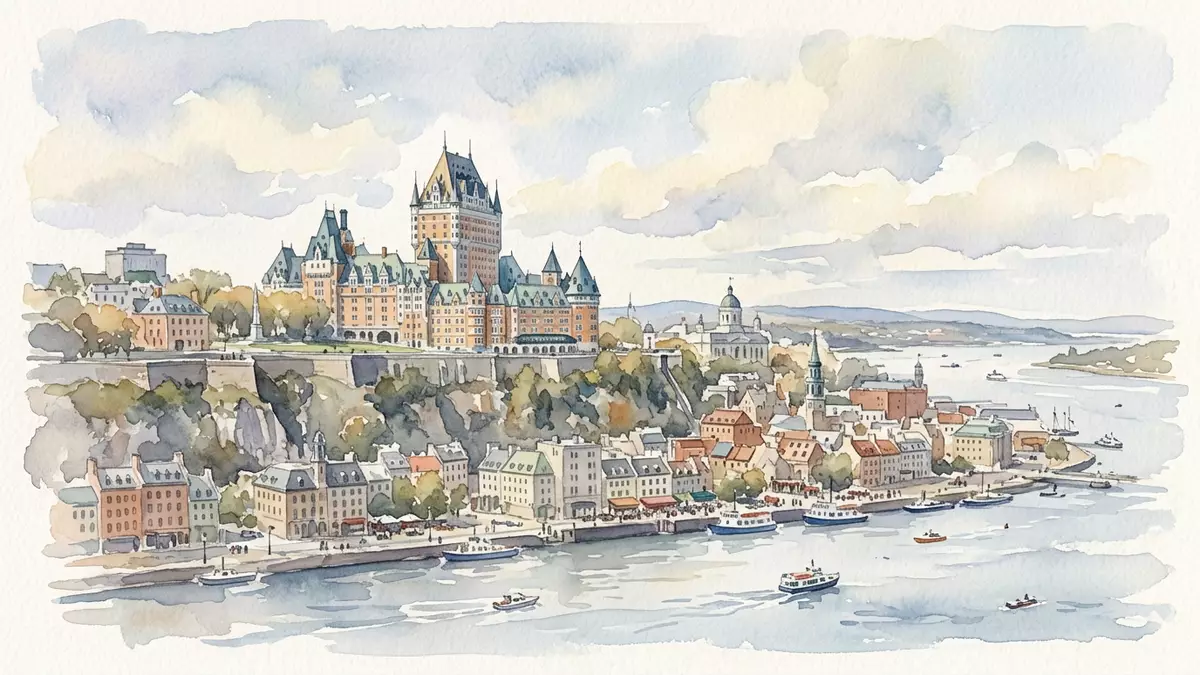
Vieux-Quebec, the historic district of Quebec City in Canada, is a walled urban quarter where an elevated upper town and a riverside lower town still read as parts of one city. The area, officially recognised as the Historic District of Old Québec and inscribed on the UNESCO World Heritage List in 1985, brings together fortifications, religious buildings and commercial streets within a compact, clearly bounded landscape.
A fortified colonial city above and below the cliff
Vieux-Quebec occupies the upper ground of Cap Diamant and the lower streets that spread out along the Saint Lawrence River and the mouth of the Saint-Charles River.The urban area of about 135 hectares is divided into two distinct parts that visitors can see directly in the change of level. The Upper Town sits on the cliff and is enclosed by ramparts, gates and other defensive works that form one of the most complete sets of fortifications in North America.The walls, citadel and related structures frame streets lined with stone buildings and public institutions.
Below the cliff, the Lower Town grew around Place Royale and the harbour, with streets close to the river and former warehouse districts that recall Quebec’s role as a trading port.This riverside quarter lies between the foot of Cap Diamant and the water, forming a tightly knit urban fabric that connects the city to its maritime setting. Seen together, the cliff, upper streets, lower streets and river give Vieux-Quebec a layered character that remains legible in the present layout.
UNESCO recognition and four centuries of urban form
UNESCO inscribed the Historic District of Old Québec on the World Heritage List in 1985 as a cultural site recognised for its fortified colonial character and its role in European settlement in the Americas.The Canadian World Heritage entries record the year and name of the district, while official documentation describes Vieux-Quebec as an exceptional example of a colonial town whose defensive ensemble and urban fabric remain coherent.The site’s World Heritage file notes how the Upper Town and Lower Town together form a well-preserved urban whole.
Quebec City itself was founded in the early seventeenth century and became the capital of New France before later serving as an administrative centre under British rule.The historic district reflects these phases through architecture that ranges from seventeenth-century houses around Place Royale to later institutional buildings and military works on the heights of Cap Diamant. The enduring street network, public squares and defensive lines show how the city grew while staying within defined limits.
Streets, landmarks and everyday life inside the walls
Within Vieux-Quebec, the Upper Town is associated with religious and administrative buildings, including churches, convents and official structures that cluster behind the ramparts.Descriptions of the Upper Town highlight monuments such as the Citadel and prominent hotels standing near the fortifications. Narrow streets and stone façades convey the sense of a longstanding urban core, while viewpoints along the walls look down towards the river and the Lower Town.
The Lower Town contains commercial streets, historic squares and port-related buildings that sit close to the Saint Lawrence River.Tourism information on Old Québec emphasises how the lower streets retain colonial architecture beside the former docks and warehouse fronts. The contrast between the compact upper quarter and the riverfront lower streets is visible in everyday movements: stairways and urban routes link the two levels, and the fortified line gives way to gateways that frame entrances into the district.
Visiting Vieux-Quebec: what travellers from Western Europe should know
- Vieux-Quebec lies within Quebec City, on the north side of the Saint Lawrence River, with the historic district reached through the city’s streets from surrounding neighbourhoods.
- The Upper Town sits on Cap Diamant above the Lower Town, so moving between levels involves gradients and stairways as well as streets that wind along the cliff.
- Old Quebec forms part of the Vieux-Québec–Cap-Blanc–Colline Parlementaire district in the borough of La Cité-Limoilou, a central area that also includes Parliament Hill and the strip of land at Cap Blanc.
- The official language is French and the currency is the Canadian dollar.
- Entry requirements depend on your nationality; UK travellers can check the FCDO travel advice at gov.uk/foreign-travel-advice, Irish travellers the Department of Foreign Affairs at ireland.ie.
Searching for Vieux-Quebec on social platforms
These links open searches for Vieux-Quebec on each platform.
Frequently asked questions about Vieux-Quebec
Where is Vieux-Quebec located?
Vieux-Quebec is the historic district of Quebec City in Canada, lying on the north side of the Saint Lawrence River and extending over Cap Diamant and the riverside streets below.
What should travellers expect when visiting Vieux-Quebec?
Travellers encounter a walled urban quarter with an Upper Town enclosed by ramparts and a Lower Town along the river, linked by streets and stairways and characterised by stone buildings and historic squares.
What makes Vieux-Quebec distinctive among historic districts?
Vieux-Quebec is distinctive as a fortified colonial city whose ramparts, citadel, Upper Town and Lower Town together form a coherent urban ensemble recognised as a UNESCO World Heritage Site since 1985.


