
Villa Adriana in Tivoli, Hadrian’s vast countryside retreat
Published on 08/13/2026 at 14:09 | Editorial responsibility: Rafael Müller, Editor-in-Chief AD HOC NEWS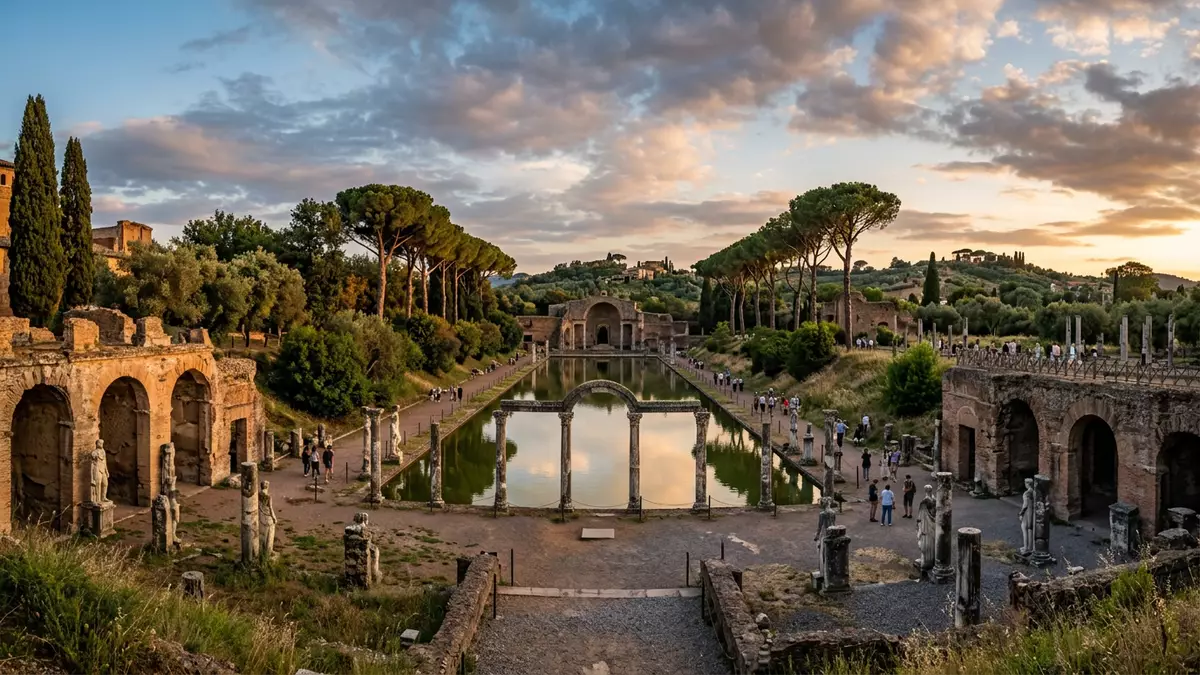
On the plain below Tivoli in Lazio, Villa Adriana spreads across the countryside as the ruin of an entire miniature city planned by the Roman emperor Hadrian in the second century AD. Built as an extensive imperial residence between the years 118 and 138 AD, the complex combines palaces, pools, theatres and gardens in stone and brick that still outline Hadrian’s idea of an ideal place to live away from Rome.
A countryside palace complex on an urban scale
Villa Adriana lies in the Tiburtine Hills east of Rome, on a plateau between streams that run towards the river Aniene, so the remains stand in open terrain rather than in the dense streets of Tivoli itself.plateau between the two tributaries The scale is immediately striking: instead of a single villa, the archaeological area covers dozens of distinct structures, set among lawns and earthworks that hint at foundations hidden below the surface.remains of some 30 buildings
The complex was laid out while Hadrian ruled the Roman Empire between 117 and 138 AD, and Villa Adriana is closely tied to his name as a patron who travelled widely across the Mediterranean world.built between 118 and 138 AD Earth-coloured masonry, marble fragments and surviving columns frame long sightlines between pavilions and water basins, so walking across the site feels less like touring one house and more like moving through a planned landscape of connected spaces.
Hadrian’s Villa as UNESCO World Heritage
Villa Adriana is recognised as a World Heritage Site, inscribed on the UNESCO list in 1999 for the way it brings together classical architecture from different parts of the ancient Mediterranean world in one residence.inscribed in 1999 as World Heritage Official descriptions emphasise the combination of Egyptian, Greek and Roman architectural traditions, visible in the forms of temples, colonnades and water features that echo monuments Hadrian knew from his travels.architectural traditions of Ancient Greece, Rome and Egypt
In practice, this means the visitor encounters a sequence of distinct ensembles: formal courtyards framed by porticoes, long pools edged in stone and terraces where statues once stood. The visitable area today extends over a large portion of the original estate, which in antiquity occupied a broad swathe of the Tiburtine countryside and functioned as an out-of-town seat of imperial power for Hadrian and his circle.monumental villa or palace complex near Tivoli
Reading the ruins as an “ideal city”
One way to approach Villa Adriana is to treat it as a city plan drawn in ruins. UNESCO and Italian cultural authorities describe the villa as an “ideal city”, a place where different building types are arranged to form a complete environment for living, governing and entertaining.designed as an ideal city Paths and ancient routes weave between residential quarters, baths, theatres and nymphaea, with water channels and pools marking transitions between more intimate and more ceremonial spaces.
The ruins invite close attention to detail: changes in brickwork, surviving fragments of mosaic floors and variations in column thickness all help distinguish the different phases of construction within Hadrian’s reign. Standing in the open, with the modern town of Tivoli visible on the slopes above, the site connects imperial Rome with the surrounding countryside and shows how an emperor of the second century shaped a personal environment at a scale that blurs the line between house and city.palatial complex comprises some 30 buildings
Visiting Villa Adriana: what travellers from Western Europe should know
- Villa Adriana stands in the municipality of Tivoli in the Lazio region, east of Rome, reached over local roads that leave the main routes towards the Tiburtine Hills.
- The archaeological area is extensive, with long, mostly uncovered walking routes across uneven ground and ancient steps, so visiting involves sustained time on foot in open terrain.
- The site lies in central Italy, where summers can be hot and winters cool, and the visitable area is largely exposed, with limited shade provided by scattered trees and surviving structures.
- Villa Adriana is part of the wider group of “Villae” monuments around Tivoli, which also includes Villa d’Este and other historic sites, making Tivoli a compact base for exploring classical and Renaissance landscapes.
- The official language is Italian and the currency is the euro.
Searching for Villa Adriana on social platforms
These links open searches for Villa Adriana on each platform.
Frequently asked questions about Villa Adriana
Where is Villa Adriana and what kind of place is it?
Villa Adriana is a large archaeological site on the plain below Tivoli in Lazio, central Italy, preserving the remains of Hadrian’s imperial country residence.
What can visitors expect when walking through Villa Adriana?
A visit involves crossing an expansive landscape of ruins, including palatial quarters, bath complexes, water basins and gardens, linked by paths and ancient routes in open terrain.
What makes Villa Adriana distinctive among Roman sites?
Villa Adriana is distinctive for its scale as a countryside residence, its design during Hadrian’s reign in the second century and its recognised role as an “ideal city” combining multiple classical traditions.


