
Villa del Balbianello and its terraced loggia in Lenno
Published on 08/14/2026 at 14:10 | Editorial responsibility: Rafael Müller, Editor-in-Chief AD HOC NEWS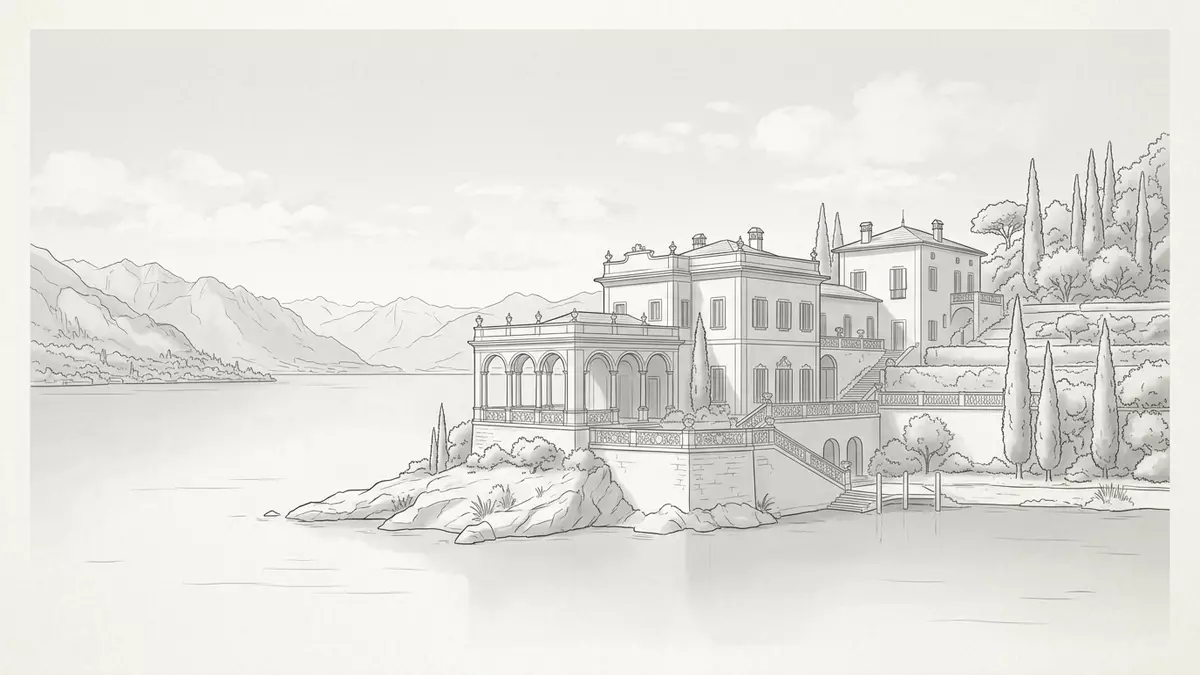
Villa del Balbianello in Lenno is a late eighteenth-century villa on a promontory above Lake Como. Its loggia, terraced gardens and lake-facing rooms make the house read as a layered composition rather than a single facade.
A villa set on a promontory
The villa sits on the western shore of the lake’s south-west branch, where the land narrows into the wooded tip of Dosso d’Avedo. The setting gives the building a clear relationship with water on two sides, and the approach stays tied to the peninsula’s contours.
The place is linked with Cardinal Angelo Maria Durini, who had it built in 1787. The name matters here because the villa’s identity is tied to a recognisable patron and a precise period, not just to an elegant lakeside address.1787
Durini, the loggia and the rooms
Durini’s villa includes a loggia and rooms arranged beside it, with the central outdoor-facing element acting as the house’s visual hinge. The composition belongs to the late eighteenth century and carries the language of leisure, conversation and cultivated display.
The site is also marked by the remains of an older Franciscan presence, including the two towers that survive from the earlier church. That earlier layer is visible without turning the villa into a reconstruction story, and the surviving masonry gives the place a stronger historical texture.Franciscan monastery
Gardens, collections and later owners
The gardens descend in terraces across the promontory, with clipped planting, paths and planted platforms following the slope. That stepped arrangement is one of the villa’s most distinctive visual features, and it places vegetation, stone and water in constant view of one another.
Guido Monzino became the last private owner in 1974 and filled the interior with travel-related objects and collected furnishings. His name belongs to the villa because the house’s later character owes much to that collecting life, and the interior preserves a strong sense of accumulated journeys.Guido Monzino
Visiting Villa del Balbianello: what travellers from Western Europe should know
- Villa del Balbianello stands on the tip of a peninsula above Lenno, overlooking Lake Como. The lake-side setting is part of the visit even before the house itself comes into view.
- The gardens rise on staggered levels, and the house is tied to a promontory with clear changes in height. That makes the place read more like a walk through layered ground than a flat villa garden.
- The surviving church towers and the loggia form two strong markers of the complex. They give the site a mix of monastic remains and later aristocratic architecture.
- The interior includes collected objects from Monzino’s travels. That material gives the rooms a private, assembled character rather than the feel of a purely formal museum house.
- The villa appears in film history as well, including Casino Royale and Star Wars: Episode II Attack of the Clones. Those titles have added another layer to an already composite place.
Searching for Villa del Balbianello on social platforms
These links open searches for Villa del Balbianello on each platform.
Frequently asked questions about Villa del Balbianello
Where is Villa del Balbianello?
It stands in Lenno, on a promontory above Lake Como in northern Italy. The villa occupies the wooded tip of Dosso d’Avedo.
What does a visit involve?
The place combines terraced gardens, a loggia, surviving church towers and rooms filled with collected objects. The layout is compact but varied, with the slope shaping movement through the grounds.
What makes it distinctive?
The villa combines an eighteenth-century aristocratic house with older monastic remains and later collecting. Its relationship to the lake is matched by the stepped gardens and the prominent loggia.


