
Volcan Villarrica and its open crater above Pucon
Published on 09/23/2026 at 03:36 | Editorial responsibility: Rafael Müller, Editor-in-Chief AD HOC NEWS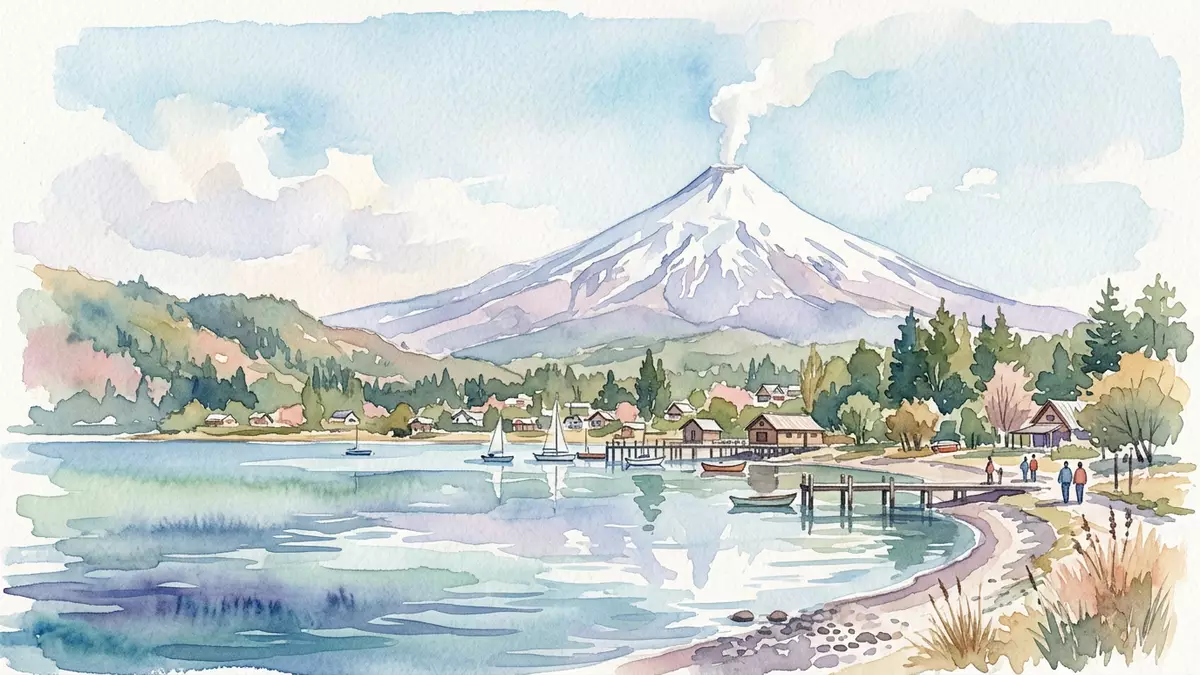
Volcan Villarrica rises above Pucon as a broad, glacier-covered cone, its summit marked by an active open crater. The mountain reaches 2,847 m (9,341 ft) and forms a striking meeting point between lava, ice, forest and Lake Villarrica.
Volcan Villarrica: a cone shaped by fire and ice
Volcan Villarrica is a stratovolcano in southern Chile’s Andes, about 15 km south of Pucon. Its name in Mapudungun is Rucapillán, a reference to the spiritual world of the Mapuche people. The mountain rises within the wider landscape of Villarrica National Park, where volcanic slopes meet native woodland and high mountain terrain.
The summit stands at 2,847 m above sea level. Snow and glacier ice cover the upper slopes, while darker lava formations and forested ground appear lower down. The cone is part of a larger volcanic complex shaped by overlapping calderas, lava flows and fragmented volcanic deposits.
Inside the crater of Rucapillán
The summit crater contains a persistent volcanic vent and fumaroles. A small lava lake has appeared within the crater during periods of activity, giving the summit a visible connection with the molten rock beneath the cone. The crater itself is an active geological feature, not a quiet depression on an extinct mountain.
Villarrica’s documented eruptions extend back to 1558. Its eruptive history includes explosive activity, lava effusion and lahars formed when water interacts with snow, ice and volcanic material. The historic eruption record places the volcano among Chile’s active volcanic centres.
Forests, lava caves and the landscape around Pucon
The lower mountain belongs to the landscape of Villarrica National Park. Araucaria and lenga forests occupy parts of the park, while old lava flows form dark, uneven ground across the volcanic terrain. Lava caves also occur on the flanks, where former molten channels hardened into underground passages.
Pucon lies beside Lake Villarrica, north-west of the volcano. Roads from the town approach the mountain through the national park, passing from settled lakeside country towards forest, volcanic rock and the ski area on the lower slopes. The park extends across the Araucanía and Los Ríos regions, with the Rucapillán sector providing the approach associated with Pucon. The national park setting includes several volcanic sectors and access routes.
Volcan Villarrica’s identity rests in the contrast visible across its slopes. A white upper cone can carry glacier ice above black lava, while native forest occupies the lower ground and Lake Villarrica lies beyond. Few mountain landscapes place an active crater, a ski area, lava caves and a lakeside town within the same geographic frame.
Visiting Volcan Villarrica: what travellers from Western Europe should know
- Volcan Villarrica lies south of Pucon in southern Chile. The approach from Pucon follows the road towards the Rucapillán sector of Villarrica National Park.
- The mountain rises to 2,847 m (9,341 ft), and the upper terrain includes snow, glacier ice, volcanic rock and an active crater.
- The lower slopes contain forest, lava formations and lava caves. The landscape changes from Lake Villarrica’s shores to high Andean terrain.
- The official language is Spanish and the currency is the Chilean peso.
- Conditions on the mountain change with the seasons; the local cable-car operators and alpine clubs provide information.
Searching for Volcan Villarrica on social platforms
These links open searches for Volcan Villarrica on each platform.
Frequently asked questions about Volcan Villarrica
Where is Volcan Villarrica?
Volcan Villarrica is in southern Chile, about 15 km south of Pucon. It rises beside Lake Villarrica within the landscape of Villarrica National Park.
What can visitors expect on the mountain?
The mountain combines forested lower slopes, lava formations, glacier-covered upper terrain and an active summit crater. The upper route is high-altitude terrain involving snow, ice and volcanic rock.
What makes Volcan Villarrica distinctive?
Its 2,847 m cone has an active crater, fumaroles and a history of eruptions recorded from 1558. The mountain also carries the Mapudungun name Rucapillán and rises above Pucon’s lake landscape.


