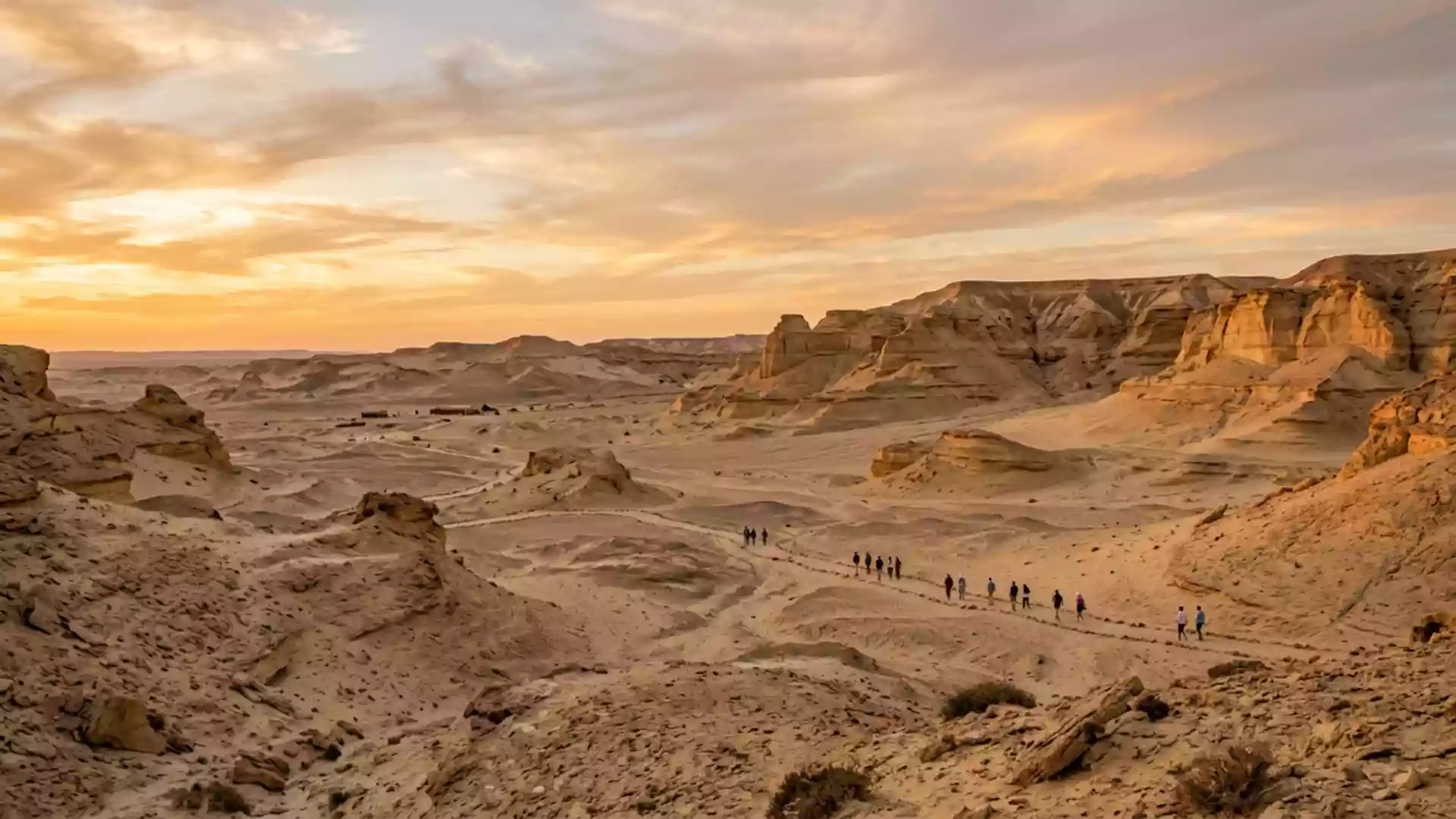
Wadi Al-Hitan’s fossil desert in the Fayyum of Egypt
Published on 08/23/2026 at 11:30 | Editorial responsibility: Rafael Müller, Editor-in-Chief AD HOC NEWS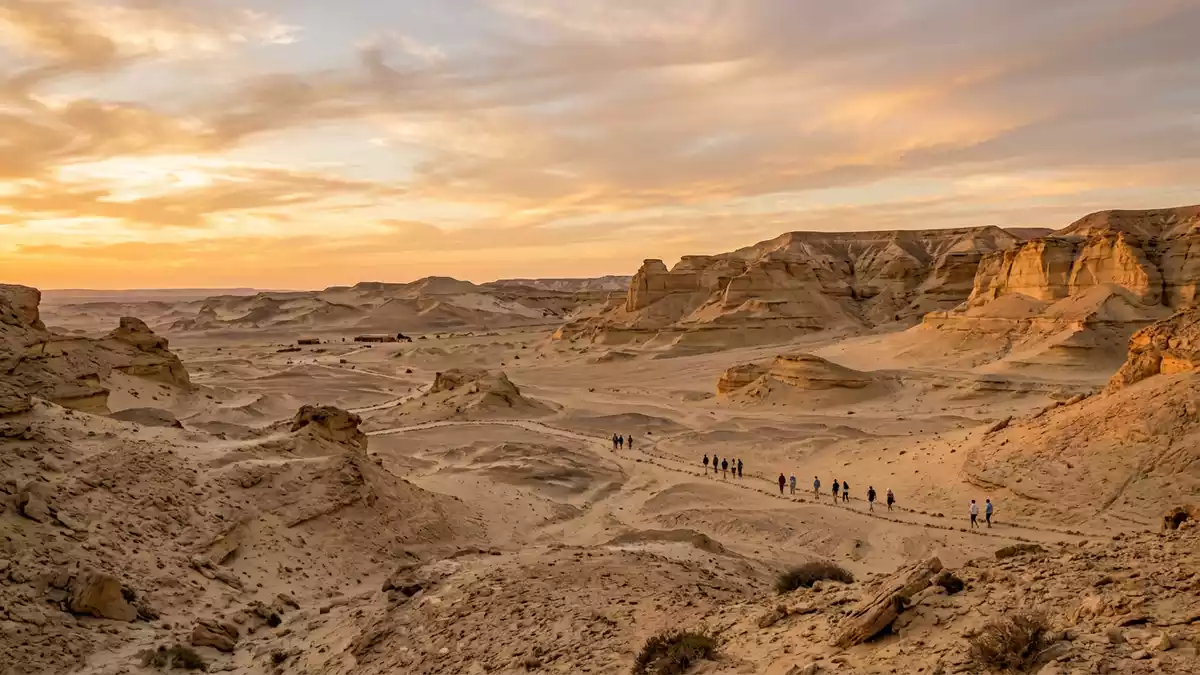
Wadi Al-Hitan in the Fayyum region of Egypt is a desert valley where ancient whale skeletons lie exposed in soft sandstone, turning a sweep of the Western Desert into a natural open-air gallery of fossils from a vanished sea.
An ancient seabed revealed in the Western Desert
Wadi Al-Hitan, often known in English as Whale Valley, lies in Egypt’s Western Desert within the wider landscape of the Fayyum Depression. The valley forms part of the Wadi El-Rayan Protected Area, a designated nature reserve that anchors this fossil-rich landscape inside a larger protected zone.Wadi El-Rayan Protected Area The surrounding desert appears as rolling sand and low rock ridges, but underfoot the bedrock records an ancient marine basin that once lay beneath a shallow sea.
This former seabed preserves an exceptional record from the Eocene period, when early whales lived in a warm coastal environment tens of millions of years ago.The nominated property Layers of sandstone and shale contain fossilised bones of marine mammals, together with traces of fish and other sea life, embedding the evidence of an ancient shoreline into the fabric of the desert. Visitors walk across terrain that combines present-day dune sand with outcrops of these older sediments, reading the shift from sea to desert directly in the rock.
Whale skeletons on the sand: an open-air fossil museum
The defining feature of Wadi Al-Hitan is the way whale fossils lie in situ across the valley floor, many preserved as near-complete skeletons that curve through the sand in the shape of the original animal.near-complete skeletons These fossils belong to the archaeocetes, an extinct suborder of whales that record the transition from land-dwelling mammals to fully marine animals. Details such as small hind limbs and elongated bodies are visible in many specimens, revealing anatomical stages that are rarely so clearly shown on the ground.
The concentration of skeletons has led Wadi Al-Hitan to be described as an open-air museum, and the landscape is arranged so that visitors follow marked paths between exposed fossils and simple interpretive signage.marked paths between exposed fossils A small Fossils and Climate Change Museum stands within the protected area, housing reconstructed skeletons and explanatory displays that complement the fossils in the desert around it. Together, the museum and the outdoor trails make it possible to trace whale evolution using bones still embedded in the rocks where they were discovered.
UNESCO World Heritage and Egypt’s first natural inscription
The global significance of Wadi Al-Hitan’s fossil record is recognised through its inscription on the UNESCO World Heritage List. The site was added in 2005 as a natural property under criteria that highlight outstanding examples of major stages of Earth’s history.inscription on the UNESCO World Heritage List In the context of Egypt, it holds the distinction of being the first natural site in the country to receive a World Heritage inscription.
UNESCO describes Wadi Al-Hitan as an exceptional reference site for the evolution of whales, because the number, quality and accessibility of its fossils show the shift from land-based to ocean-going mammals with unusual clarity.exceptional reference site The valley’s combination of intact skeletons, surrounding sedimentary structures and a desert setting that remains largely undeveloped gives researchers and travellers a shared vantage point on a key chapter in natural history.
Visiting Wadi Al-Hitan: what travellers from Western Europe should know
- Wadi Al-Hitan lies in the Fayyum Depression of Egypt’s Western Desert, west of Fayyum city, and is reached by road through the Wadi El-Rayan Protected Area.
- The terrain consists of desert sand, low rock ridges and designated walking trails, and visiting the outdoor fossil sites involves walking on unshaded paths over uneven ground.
- The valley forms part of a protected area in Egypt; the official language is Arabic and the currency is the Egyptian pound.
- Entry requirements depend on your nationality; UK travellers can check the FCDO travel advice at gov.uk/foreign-travel-advice, Irish travellers the Department of Foreign Affairs at ireland.ie.
Searching for Wadi Al-Hitan on social platforms
These links open searches for Wadi Al-Hitan on each platform.
Frequently asked questions about Wadi Al-Hitan
Where is Wadi Al-Hitan located?
Wadi Al-Hitan is in the Fayyum region of Egypt’s Western Desert, within the Wadi El-Rayan Protected Area west of Fayyum city.
What should visitors expect when exploring Wadi Al-Hitan?
Visitors encounter marked desert trails, exposed whale fossils preserved in the sand and a small museum that displays reconstructed skeletons and interpretive exhibits.
What makes Wadi Al-Hitan distinctive among fossil sites?
Wadi Al-Hitan combines numerous early whale skeletons preserved in place with a protected desert setting, providing a clear record of whale evolution in a single landscape.