
Wanli Changcheng and the long line of stone across northern China
Published on 09/22/2026 at 20:01 | Editorial responsibility: Rafael Müller, Editor-in-Chief AD HOC NEWS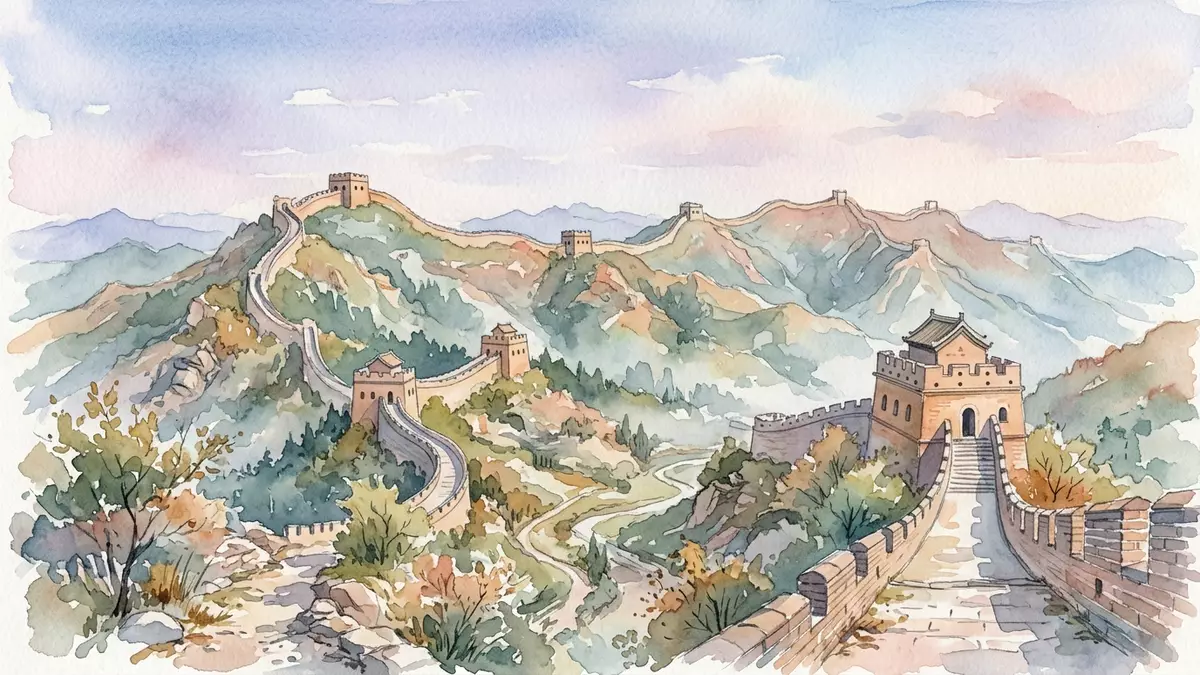
Wanli Changcheng is a chain of walls, passes, towers and earthworks crossing northern China. Around Peking, its most recognisable stretches run over ridges in brick and stone, while the name itself means “10,000-Li Long Wall”.
Wanli Changcheng: a wall made from many walls
The Great Wall is not a single uninterrupted barrier. It is a historical defence system whose parts were built, joined, repaired and extended across many centuries. Its features include ramparts, watchtowers, shelters, fortresses, passes and tracks along the wall.
The earliest sections belong to the period of competing Chinese states. Defensive walls appeared from the seventh century BC, with major construction during the Spring and Autumn period and the Warring States period. The surviving system therefore contains earthwork traditions as well as the masonry associated with the best-preserved stretches.
From Qin Shi Huang to the Ming dynasty
In 221 BC, Qin Shi Huang unified China under the Qin dynasty. Around 220 BC, sections of earlier fortifications were joined into a larger defence system. Qin Shi Huang and the early wall belong to the first major phase of the structure’s shared history.
Construction continued through successive empires and reached its most familiar form under the Ming dynasty, which ruled from 1368 to 1644. Ming builders used brick and stone for extensive mountain sections, adding wall walks, parapets, gates, towers and fortified passes. The Ming dynasty wall measures about 8,850 km (5,499 miles) when its associated sections are counted together.
Ridges, towers and the scale of the route
Near Peking, the wall follows mountain crests and folds around steep slopes. Its masonry sections have a broad walking surface, parapets along the edges and towers placed at intervals. The route rises and falls with the terrain, producing stairways, sloping paths and changing views across the ridges.
The complete network is longer than the visible masonry line alone. It includes constructed walls, trenches and natural defensive features such as rivers and mountain ridges. The total recorded length exceeds 20,000 km (12,427 miles), while the Ming wall forms a distinct historical layer within that wider system. Wanli Changcheng became a UNESCO World Heritage site in 1987, and its protected property includes fortresses, passes, beacon towers and wall sections. The wall’s varied dimensions reflect the different periods and landscapes represented along its route.
Visiting Wanli Changcheng: what travellers from Western Europe should know
- Wanli Changcheng lies north of Peking, with accessible sections reached by road from the capital and by local transport serving individual mountain passes.
- The approach involves steep slopes, steps and uneven gradients. Brick wall walks follow ridgelines, while towers stand at changing elevations.
- Mountain sections contain exposed parapets, narrow stairways and long stretches without level ground. The terrain is part of the physical character of the site.
- The official language is Mandarin Chinese and the currency is the Chinese yuan.
- Entry requirements depend on your nationality; UK travellers can check the FCDO travel advice at gov.uk/foreign-travel-advice, Irish travellers the Department of Foreign Affairs at ireland.ie.
Searching for Wanli Changcheng on social platforms
These links open searches for Wanli Changcheng on each platform.Frequently asked questions about Wanli Changcheng
Where is Wanli Changcheng?
Wanli Changcheng crosses northern China, with prominent mountain sections north of Peking. The route extends between historic passes and fortifications across several provinces.
What can visitors expect on a visit?
Visitors encounter brick and stone wall walks, towers, parapets, steep steps and ridgelines. Conditions vary between restored masonry sections and older earthwork remains.
What makes Wanli Changcheng distinctive?
Its defining feature is its scale as a layered defence system rather than a single building. Qin, Han, Ming and other historical phases appear across a route exceeding 20,000 km (12,427 miles).


