
Wat Arun and its porcelain tower on the Chao Phraya
Published on 08/24/2026 at 11:49 | Editorial responsibility: Rafael Müller, Editor-in-Chief AD HOC NEWS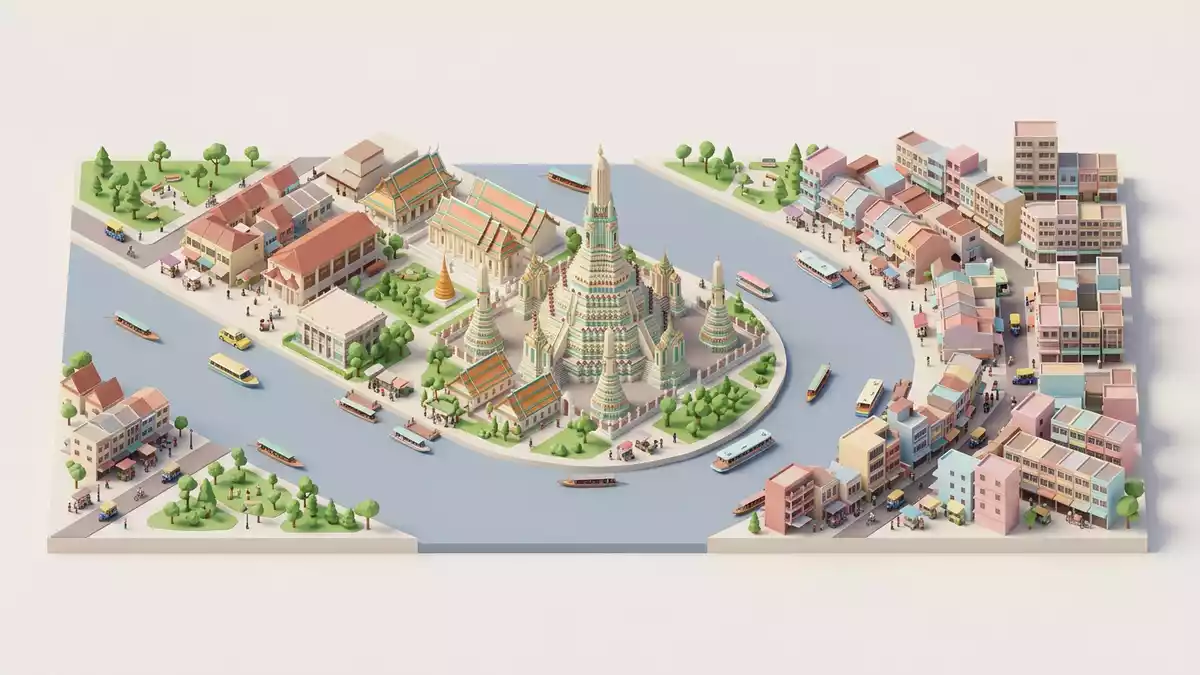
Wat Arun in Bangkok is best known for its towering Khmer-style prang clad in porcelain, a riverside landmark that ties the Ayutthaya period to the early Rattanakosin era in one temple complex. Standing on the Thonburi bank of the Chao Phraya River, it developed from an Ayutthaya-era shrine into a royal temple under King Taksin in the late eighteenth century and took on its defining form under Rama II and Rama III in the first half of the nineteenth century.
The riverfront temple of the dawn
Wat Arun stands on the west bank of the Chao Phraya River in the Bangkok Yai district, directly facing the old royal centre on Rattanakosin Island across the water.The temple is officially known as Wat Arun Ratchawararam and occupies a riverside plot that has been a Buddhist site since the Ayutthaya Kingdom in the seventeenth century.
In the Thonburi era after the fall of Ayutthaya in 1767, General Taksin made this stretch of river his capital, elevating the then modest Wat Makok and restoring it as his palace temple.During this period the temple became known as Wat Chaeng, the Temple of Dawn, a name later replaced in official usage by Wat Arun, derived from Aruna, the Hindu deity associated with the rising sun.The association with dawn reflects Taksin’s arrival at the site at first light in 1768.
Porcelain, stucco and the central prang
The dominant feature of Wat Arun is its central prang, a Khmer-style tower rising to around 82 m (269 ft), flanked by four smaller satellite prangs around the main platform.This composition represents Mount Meru and four surrounding sacred mountains in Buddhist and Hindu cosmology, expressed in brick and stucco rather than rock. The central tower is approached by steep exterior stairways, which lead to terraces from which visitors look across the river to the Grand Palace and Wat Phra Kaew.
The prang took its present height and decoration in the early Rattanakosin period.Work to enlarge the tower began under King Rama II in the early nineteenth century, who raised it significantly and restructured the surrounding temple compound. King Rama III continued the project and completed the decoration around 1851, using an unusual material palette.Broken pieces of Chinese porcelain carried as ballast on trading ships were pressed into fresh stucco to form floral and geometric mosaics, giving the prang its distinctive surface of coloured shards.
Courtyards, ordination hall and river context
Beyond the prang, Wat Arun is laid out as a full temple complex with courtyards, cloisters and halls that show layers of nineteenth-century craftsmanship. The main ubosot, or ordination hall, stands to the east of the prang and houses a principal Buddha image linked to Rama II, whose ashes are interred beneath it.Murals in the ordination hall date from the reign of Rama V, King Chulalongkorn, between 1868 and 1910, adding a later Rattanakosin layer to the site’s decoration.
The temple enclosure carries Chinese guardian statues, small pavilions and minor shrines, many incorporating porcelain and coloured glass alongside stuccoed reliefs. Around the perimeter, galleries shelter rows of seated Buddha images beneath tiled roofs.The complex forms one of the major riverside temples of Bangkok, facing a cluster of historic sites across the water and marking the transition from the Thonburi capital to the Bangkok era in its fabric and layout.
Visiting Wat Arun: what travellers from Western Europe should know
- Wat Arun stands in the Wat Arun subdistrict of Bangkok Yai on the Thonburi side of the Chao Phraya River, opposite the Grand Palace and Wat Phra Kaew across the water.
- The ascent of the central prang involves steep exterior stairways with narrow steps; movement between terraces requires care and may not suit every visitor.
- River ferries connect Tha Tien pier on the Rattanakosin side with piers near Wat Arun, giving direct boat access between the old royal quarter and the temple.
- The official language is Thai and the currency is the baht.
Searching for Wat Arun on social platforms
These links open searches for Wat Arun on each platform.
Frequently asked questions about Wat Arun
Where is Wat Arun located in Bangkok?
Wat Arun stands on the Thonburi, or west, bank of the Chao Phraya River in the Wat Arun subdistrict of Bangkok Yai, opposite the historic Rattanakosin quarter.
What should visitors expect on a visit to Wat Arun?
Visitors encounter a temple complex centred on a tall Khmer-style prang with steep stairways, surrounded by courtyards, galleries with Buddha images and an ordination hall with nineteenth-century murals.
What makes Wat Arun distinctive among Bangkok’s temples?
The central prang’s height, Khmer-inspired silhouette and skin of multicoloured porcelain mosaics, together with its position on the river opposite the old royal palaces, make Wat Arun visually distinctive.


