
Wat Pho and Bangkok’s 46-metre reclining Buddha
Published on 09/24/2026 at 10:21 | Editorial responsibility: Rafael Müller, Editor-in-Chief AD HOC NEWS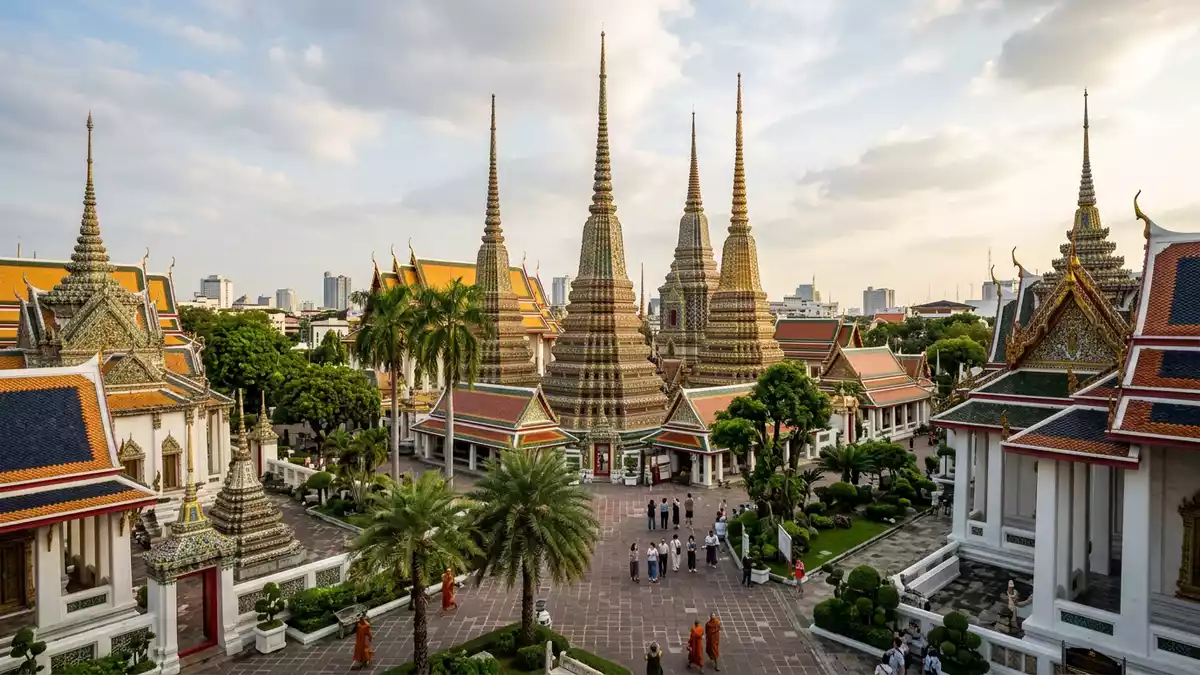
Wat Pho is a Bangkok temple complex where architecture, Buddhist imagery and public learning share the same enclosed grounds. Its reclining Buddha measures 46 metres from head to foot, giving the site a clear visual centre and a scale that continues through the surrounding galleries.
Wat Pho: the reclining Buddha and its enclosing galleries
The reclining figure lies within the West Vihara, its body covered in gold leaf and its feet decorated with mother-of-pearl inlay. The soles carry 108 auspicious symbols, arranged as a dense field of Buddhist imagery. The statue dates from the reign of King Rama III and was completed in 1848. Wat Pho’s official history records the West Vihara among the structures associated with the temple’s great restoration.
Wat Pho does not end with the reclining figure. Cloisters, vihara halls, chedi and courtyards create a layered composition of painted surfaces, glazed tiles, stone sculpture and gilded decoration. The complex stands beside the Grand Palace in the Phra Nakhon district, close to the Chao Phraya River and Sanam Chai Road.
From Ayutthaya foundations to the Chakri period
The temple’s earlier name was Wat Photharam, and its origins reach back to the Ayutthaya period. King Rama I restored the monastery after Bangkok became the capital, while King Rama III extended its buildings and added major elements to the complex. The present name is Wat Phra Chetuphon Wimon Mangkhalaram Rajwaramahawihan.
Work during the reign of Rama III gave Wat Pho a role beyond worship. Marble inscriptions placed around the temple record subjects including medicine, literature, geography and Buddhist teaching. These inscriptions form part of the temple’s identity as a place where knowledge was displayed in public, alongside murals, statues and architectural decoration. The temple’s inscription archive entered UNESCO’s Memory of the World Register in 2011.
Marble inscriptions, Thai massage and living religious space
Wat Pho is also associated with traditional Thai medicine and massage. The temple’s stone panels preserve practical and scholarly material, while its halls remain part of a functioning Buddhist monastery. Monks, worshippers, architectural details and devotional images occupy the same complex.
The visual language shifts from the reclining Buddha’s long golden form to the smaller images in the galleries and the patterned surfaces of the halls. Chinese porcelain appears in decorative work, while guardian figures and stone sculptures stand near entrances and courtyards. The result is a place read through repeated details: tiled roofs, painted doors, carved stone and inscriptions close to eye level. The 46-metre reclining Buddha remains the clearest single reference point within the larger compound.
Visiting Wat Pho: what travellers from Western Europe should know
- Wat Pho is in Phra Nakhon, Bangkok, beside the Grand Palace and near Sanam Chai Road. The Sanam Chai underground station and river boats provide named transport connections.
- The complex contains courtyards, tiled walkways and temple halls. Visitors move between open areas and enclosed vihara buildings, with footwear removed in designated interiors.
- The official language is Thai and the currency is the Thai baht.
- Wat Pho is an active Buddhist monastery. Clothing that covers shoulders and knees fits the religious setting.
Searching for Wat Pho on social platforms
These links open searches for Wat Pho on each platform.
Frequently asked questions about Wat Pho
Where is Wat Pho?
Wat Pho is in Bangkok’s Phra Nakhon district, beside the Grand Palace and near the Chao Phraya River. Its address is associated with Sanam Chai Road.
What can visitors see at Wat Pho?
The complex contains the 46-metre reclining Buddha, temple halls, chedi, courtyards, murals, glazed tiles, stone figures and marble inscriptions. It remains an active Buddhist monastery.
What makes Wat Pho distinctive?
Wat Pho combines a large reclining Buddha with a royal monastery complex and an extensive body of public inscriptions. Its buildings connect Buddhist worship with Thai artistic and medical traditions.


