
Wat Pho and the reclining Buddha of Bangkok
Published on 08/18/2026 at 14:38 | Editorial responsibility: Rafael Müller, Editor-in-Chief AD HOC NEWS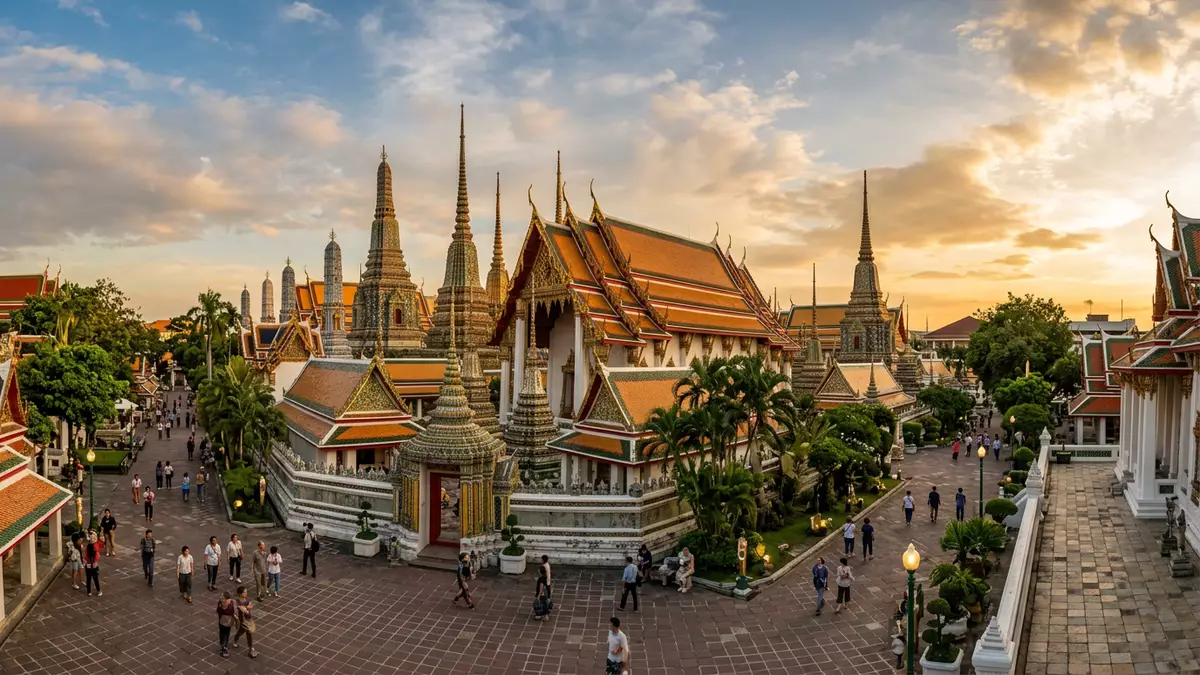
Wat Pho, formally known as Wat Phra Chetuphon Wimon Mangkhalaram, is a royal Buddhist monastery in Bangkok whose centrepiece is a monumental reclining Buddha surrounded by a dense complex of halls, chapels and chedis. Its position beside the Grand Palace on Rattanakosin Island and its long association with the Chakri kings tie it closely to the founding era of Bangkok in the late eighteenth century.
A royal monastery beside the Grand Palace
Wat Pho stands on Rattanakosin Island in Bangkok’s historic Phra Nakhon district, immediately south of the Grand Palace and the Temple of the Emerald Buddha. The complex occupies a large block between Sanam Chai Road and the Chao Phraya River, with gates leading in from the surrounding streets and lanes.
The monastery has roots in the Ayutthaya period, when a temple known as Wat Phodharam stood on this site. After King Rama I established Bangkok as the capital in 1782, he ordered the restoration and expansion of Wat Phodharam, elevating it to first-grade royal monastery status and giving it the new name Wat Phra Chetuphon Vimolmangklavas.King Rama I restored Wat Phodharam in 1788 The restoration work under Rama I continued into the early nineteenth century, with a major celebration recorded in 1801.
Under King Rama III, in the first half of the nineteenth century, the temple complex expanded again with new halls and courtyards. During this period, the large reclining Buddha and its housing hall were constructed, and the official name evolved into the form used today, Wat Phra Chetuphon Wimon Mangkhalaram Rajwaramahawihan.The complex is classed as a first grade royal monastery The result is a layered ensemble of buildings that reflects successive reigns of the early Chakri dynasty.
The reclining Buddha and the main vihara
The reclining Buddha of Wat Pho stretches along the length of the principal vihara, its gilded body filling almost the entire hall. The image dates to the reign of King Rama III and measures around 46 m in length and 15 m in height, depicting the Buddha lying on his side with his head supported on one arm.The reclining Buddha is 46 m long The entire figure is covered in gold leaf, catching the light against the darker interior.
The feet of the Buddha form a focal point at one end of the hall. Each sole is decorated with intricate mother-of-pearl inlay depicting auspicious characteristics, or laksanas, associated with the Buddha.The soles carry mother-of-pearl scenes Along the length of the wall opposite the statue, narrow aisles run between pillars and rows of small Buddha images, while bronze bowls line another side of the hall.
Beyond the main vihara, Wat Pho contains a large collection of Buddha images assembled from different parts of Thailand. Many of these stand in long colonnades around courtyards, framed by painted cloister walls and the tiled roofs of surrounding halls.The complex contains more than 1,000 Buddha statues Together, they give the impression of a walking gallery of Buddhist sculpture in differing poses and styles.
Chedis, courtyards and a centre of learning
Wat Pho is known not only for its great Buddha image but also for the clusters of chedis that punctuate its courtyards. Near the core of the complex stands a group of chedis associated with the Chakri kings, their bases and bodies faced with coloured tiles and reliefs. Elsewhere in the grounds, smaller chedis and decorative prangs rise between the cloister galleries.
The temple has long associations with learning and traditional medicine. In the reigns of Rama I and Rama III, scholars inscribed texts on stone tablets covering subjects such as literature, history, massage and herbal medicine, mounting them on the walls of the complex.Inscriptions record traditional Thai knowledge Wat Pho is closely linked with traditional Thai massage, and a massage school operates within the grounds, continuing that instructional role for visitors and students.
The buildings themselves follow familiar central-Thai temple forms: multi-tiered roofs with bright glazed tiles, gables ornamented with mirror mosaics and timber doors painted with floral and mythical motifs. Within the innermost precinct, ordination halls and chapels stand around paved courtyards, with guardian statues and Chinese stone figures marking thresholds and corners.Wat Pho is recognised as one of the principal temples in Thailand The combination of enclosed cloisters, open courts and vertical markers gives the complex a layered, almost city-like structure.
Visiting Wat Pho: what travellers from Western Europe should know
- Wat Pho stands in the Phra Nakhon district of Bangkok on Rattanakosin Island, just south of the Grand Palace and Wat Phra Kaew, between Sanam Chai Road and the Chao Phraya River.
- The Chao Phraya River Express boats stop at Tha Tien pier on the opposite side of the road from Wat Pho, and river transport is a common way to reach this part of the city.
- Inside the complex, movement between the vihara, ordination hall and courtyards involves paved paths, steps at gateways and thresholds, and shaded walkways around cloisters and chedis.
- The official language is Thai and the currency is the baht. Entry requirements depend on your nationality; UK travellers can check the FCDO travel advice at gov.uk/foreign-travel-advice, Irish travellers the Department of Foreign Affairs at ireland.ie.
Searching for Wat Pho on social platforms
These links open searches for Wat Pho on each platform.
Frequently asked questions about Wat Pho
Where is Wat Pho in Bangkok?
Wat Pho stands in the historic Phra Nakhon district of Bangkok on Rattanakosin Island, immediately south of the Grand Palace and near the Chao Phraya River.
What can visitors expect inside Wat Pho?
Visitors enter a large temple complex of halls, cloisters and courtyards centred on a gold-covered reclining Buddha, with numerous Buddha statues, chedis and shaded walkways.
What makes Wat Pho distinctive among Bangkok’s temples?
Wat Pho combines a monumental reclining Buddha from the reign of King Rama III with an extensive collection of Buddha images and a longstanding role as a centre of Thai learning and massage.


