
Wat Pho and the temple of the reclining Buddha
Published on 08/22/2026 at 12:24 | Editorial responsibility: Rafael Müller, Editor-in-Chief AD HOC NEWS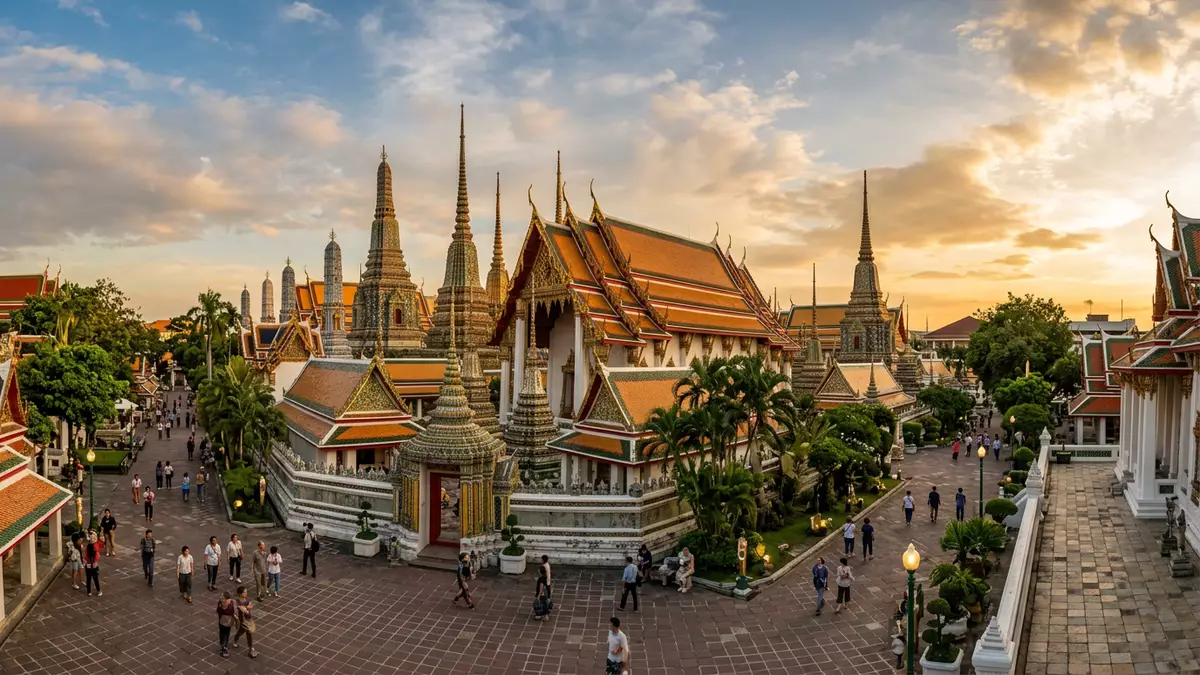
Wat Pho in Bangkok is best known for its reclining Buddha, yet the temple complex spreads across a broad monastic enclosure filled with chapels, chedi and teaching halls that show how faith, royal patronage and learning have intertwined in Thailand over centuries. Its official name, Wat Phra Chetuphon Wimon Mangkhalaram Rajwaramahawihan, links the site to the Chakri Dynasty and the reign of King Rama I in the late eighteenth century, when the complex was rebuilt on an older Ayutthaya-era monastery.
A royal temple shaped over centuries
Wat Pho stands on Rattanakosin Island in Bangkok, close to the Grand Palace and the Chao Phraya River, in a quarter where royal and religious buildings sit side by side. The temple occupies the site of Wat Photharam, a monastery already in existence during the Ayutthaya period and linked in chronicles to the reign of King Phetracha in the late seventeenth century, giving the complex roots that reach back before Bangkok became the capital.Ayutthaya-period origins When King Rama I established Bangkok as the capital in the 1780s he ordered the restoration and enlargement of this temple, and the work culminated with its inauguration under a new royal name at the start of the nineteenth century.renamed under Rama I
The complex seen today largely took shape under King Rama III in the nineteenth century, in a restoration and expansion programme that extended the grounds and added major structures such as the library hall and additional vihara chapels.restoration under Rama III This campaign, running for more than a decade, gave Wat Pho its present layout as a first-grade royal monastery in the Bangkok classification system, linking it formally to the Chakri court and cementing its status as one of the principal temple complexes of the capital. The long history means that details in stone, stucco and glazed ceramics often sit side by side, carrying motifs from different periods and dynasties within one enclosure.
The reclining Buddha and the cloistered courtyards
The reclining Buddha of Wat Pho is housed in the West Vihara, a purpose-built hall dating from the reign of Rama III whose scale reflects the size of the image within.West Vihara with reclining Buddha The Buddha image stretches almost the length of the hall, clad in gold-coloured leaf, with the soles of its feet inlaid with mother-of-pearl panels arranged in symbolic diagrams. Visitors walking along the flanks of the image pass close to its shoulder and feet, seeing details such as the tight curls of the head and the raised platform that supports the reclining pose. The hall itself uses painted beams, patterned columns and a relatively low roof compared with the surrounding chedi, so that the focus stays on the horizontal image.
Beyond the reclining Buddha hall, Wat Pho is organised around a core cloister, where rows of standing and seated Buddha statues line arcades beneath tiled roofs.collection of Buddha images In the open courtyards between these cloisters rise several groups of chedi clad in glazed ceramic tiles and coloured faience, with bases, bodies and spires covered in floral motifs and small niches. Some chedi are associated with particular kings of the Chakri Dynasty, making them both religious monuments and dynastic markers. Smaller chapels and pavilions dot the complex, many with multi-tiered roofs and finials characteristic of Bangkok-era temple architecture, creating a dense ensemble of structures within a relatively compact walled precinct.
Wat Pho as a centre of learning and traditional medicine
Wat Pho is known not only as a temple but also as a historic centre for education, particularly in traditional Thai medicine and massage. In the nineteenth century, during the reign of King Rama III, the temple became a place where knowledge was formally inscribed in stone, with hundreds of carved panels set up around the grounds to record medical recipes, massage techniques and other aspects of Thai culture.stone inscriptions on medicine These inscriptions created a kind of outdoor archive, turning the temple into a reference point for practitioners and learners long before modern universities expanded.
That educational role survives in the presence of teaching halls and massage pavilions within the complex, where traditional Thai massage and related therapies are taught and practised.traditional Thai medicine and massage The link between religious devotion and medical practice is visible in the way anatomical drawings and massage diagrams appear on walls close to religious imagery, suggesting that bodily well-being and spiritual life are understood as connected domains. For visitors, this gives Wat Pho a distinctive second dimension: it functions simultaneously as a place of worship, a repository of royal history and a living school for Thai therapeutic traditions.
Visiting Wat Pho: what travellers from Western Europe should know
- Wat Pho stands in the historic Rattanakosin district of Bangkok, south of the Grand Palace, and is reached by city streets and river transport along the Chao Phraya.
- The temple grounds include paved courtyards, interior halls and cloister walks, with numerous steps leading into chapels and around the reclining Buddha hall.
- The Chao Phraya River runs nearby, with Tha Tien pier and the temple of Wat Arun on the opposite bank providing further historic sites within close reach.
- The official language is Thai and the currency is the baht; entry requirements depend on your nationality, UK travellers can check the FCDO travel advice at gov.uk/foreign-travel-advice, Irish travellers the Department of Foreign Affairs at ireland.ie.
Searching for Wat Pho on social platforms
These links open searches for Wat Pho on each platform.
Frequently asked questions about Wat Pho
Where is Wat Pho located in Bangkok?
Wat Pho is situated in the Rattanakosin district of Bangkok, near the Grand Palace and close to the eastern bank of the Chao Phraya River.
What should visitors expect when entering Wat Pho?
Visitors encounter a walled temple complex with cloistered courtyards, chedi clusters, chapels and the large reclining Buddha hall, all connected by paved paths and steps.
What makes Wat Pho distinctive among Bangkok temples?
Wat Pho combines the reclining Buddha image, dynastic chedi linked to Chakri monarchs and a documented role as a centre for traditional Thai medicine and massage within one complex.


