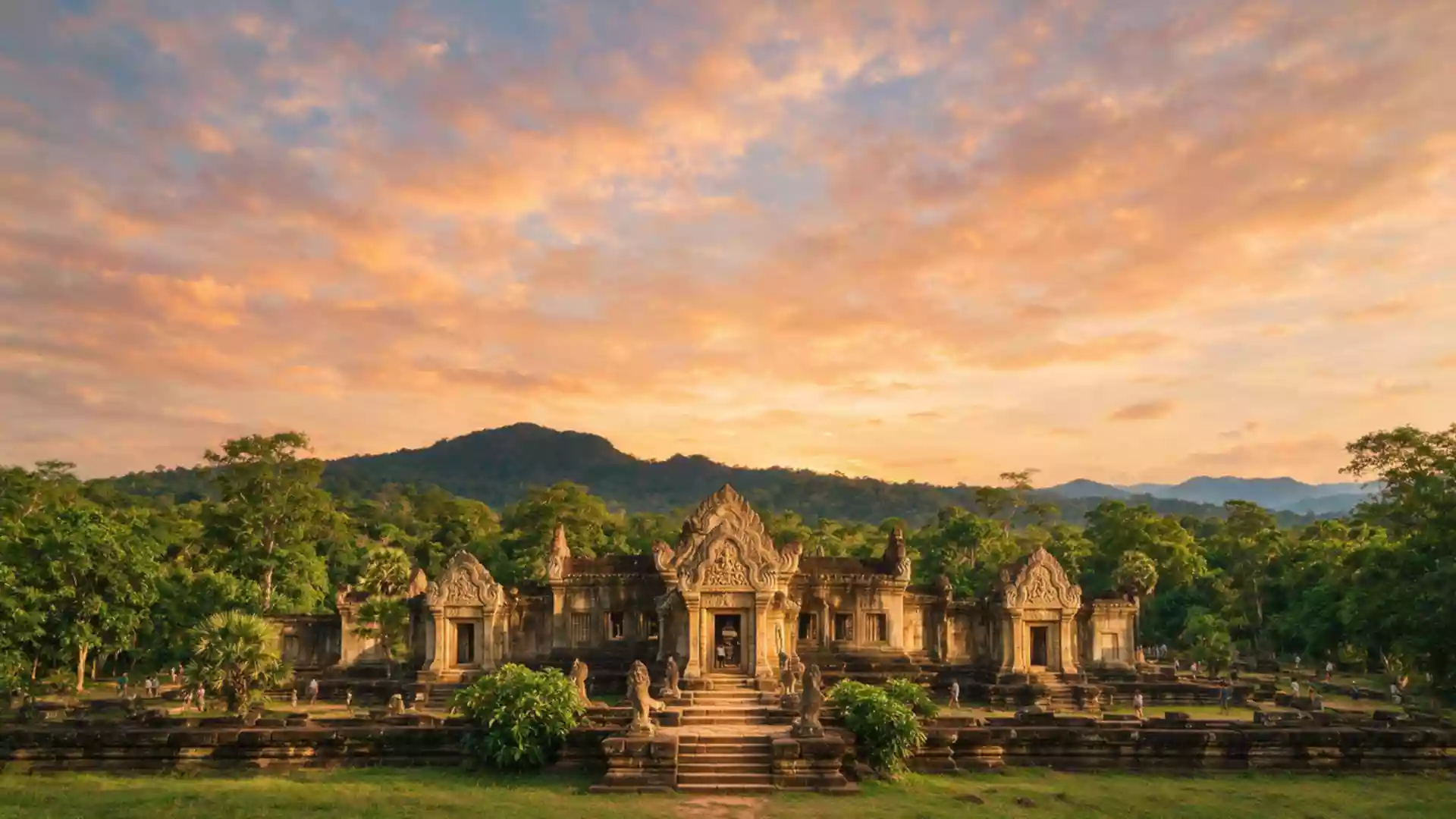
Wat Phou: a Khmer temple rising above the Mekong plain
Published on 08/15/2026 at 14:39 | Editorial responsibility: Rafael Müller, Editor-in-Chief AD HOC NEWS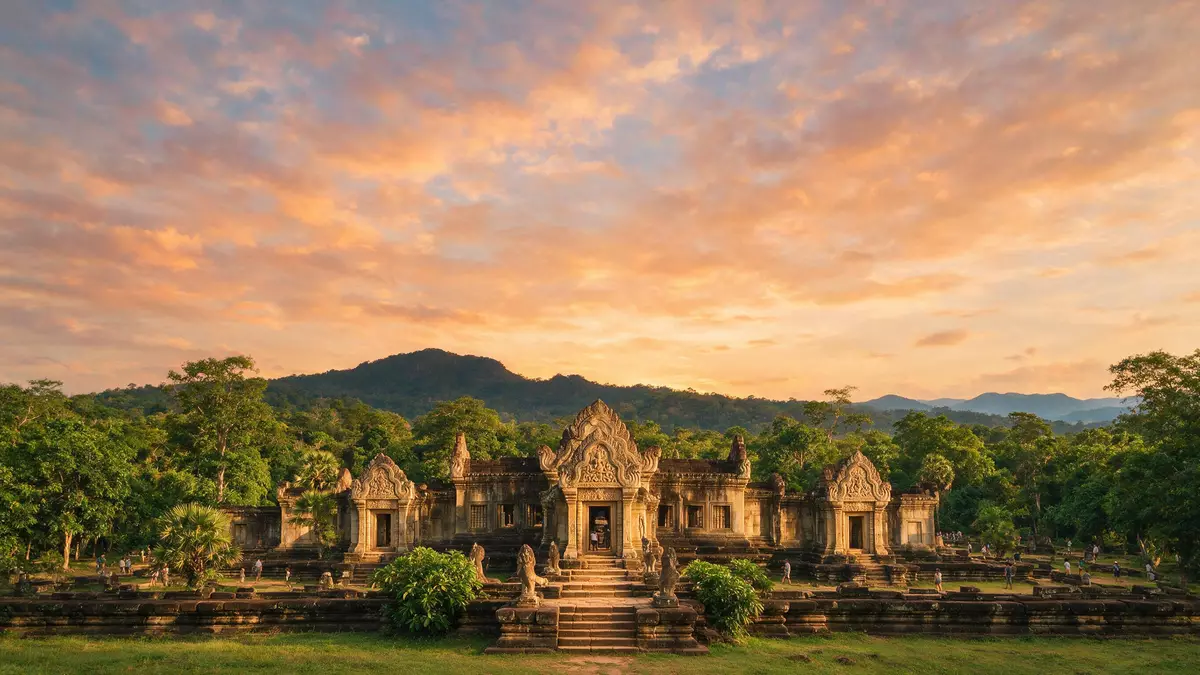
Wat Phou in Champasak, southern Laos, is an ancient Khmer temple complex that climbs the lower slopes of Phou Kao Mountain above the Mekong plain, forming a vast planned landscape shaped over more than a thousand years. Its stone terraces, reservoirs and sanctuaries trace an axis from the river towards the mountain, offering one of Southeast Asia’s most striking examples of a temple integrated into its wider terrain and cultural setting from the early medieval period.
A temple-mountain on the flank of Phou Kao
Wat Phou lies in Champasak Province in southern Laos, near the town of Champasak and a short distance inland from the Mekong River on the west bank.its location in Champasak Province The complex sits at the base of Phou Kao, a mountain that has long held sacred significance, with the temple arranged along an east–west axis that runs from the former urban area on the plain up towards the cliffs and a natural spring.an axis extending from the plain towards the cliff The name Wat Phou is often translated from Lao as “temple-mountain”, reflecting this combination of religious structure and elevated terrain.the temple-mountain meaning of the name
The temple complex is set some kilometres from the Mekong, with the river forming part of the wider Champasak cultural landscape that surrounds the site.its position near the Mekong plain Approaching Wat Phou, visitors move from the river valley and the low townscape into an area of fields and ponds, before reaching the stone causeway that marks the beginning of the sacred approach. The gradual ascent, laid out in terraces, is a defining experience of the site, with the path climbing towards the main sanctuary that stands on a high platform at the base of the mountain cliffs where a spring flows.
Khmer architecture and a long religious history
Wat Phou is a Khmer temple complex whose surviving architecture belongs largely to the period between the seventh and the thirteenth centuries AD.early and classic Khmer architecture of the 7th–12th centuries The ruins include galleries, courtyards and sanctuary buildings laid out along the central axis, built in sandstone and laterite and decorated with characteristic Khmer carvings. Many of the structures belong to what is often called the classic Angkor period, though the religious use of the mountain predates the great city of Angkor itself.a monumental ensemble of Khmer art predating Angkor Wat
The sanctuary at the uppermost terrace of Wat Phou was originally dedicated to the Hindu god Shiva and formed one of the earliest Khmer mountain sanctuaries.a sanctuary dedicated to Shiva Over the centuries, as religious practices in the region changed, the temple complex became associated with Theravada Buddhism, and Buddhist images are now present within the structures.its transition from Hindu temple to Buddhist site Epigraphic evidence links the site to the Khmer Empire between the eighth and twelfth centuries, and inscriptions and architectural details indicate that major building phases took place in the eleventh century under King Suryavarman I and later rulers.building phases under Khmer kings
A World Heritage cultural landscape
Wat Phou is the central monument within what UNESCO describes as the Champasak cultural landscape, a planned sacred landscape that extends from the Mekong River across the plain and up onto the slopes of Phou Kao.the Champasak cultural landscape and Vat Phou This landscape incorporates the temple complex itself, ancient settlement remains, and associated features such as processional ways and water structures, forming an integrated design that has been in place for over 1,000 years.a planned landscape more than 1,000 years old In 2001, “Vat Phou and Associated Ancient Settlements within the Champasak Cultural Landscape” was inscribed on the UNESCO World Heritage List, recognising both the temple architecture and the broader setting.its World Heritage inscription in 2001
The alignment of Wat Phou and the surrounding landscape reflects a relationship between the Khmer sacred city on the plain, the river and the mountain sanctuary. Archaeological remains of the urban settlement extend for kilometres across the fields below the temple, linked to the upper terraces by long processional ways. From the higher levels of the complex, views open across the cultural landscape towards the Mekong, reinforcing the sense that the temple, the mountain and the river formed a single sacred and political ensemble within the Khmer Empire.
Visiting Wat Phou: what travellers from Western Europe should know
- Wat Phou is reached from Champasak town by travelling inland from the west bank of the Mekong River towards the base of Phou Kao Mountain, where the temple complex begins with a long stone causeway across the plain.
- The ascent through the complex involves walking along causeways and climbing stone stairways that rise through several terraces to the main sanctuary on a higher platform beneath the cliffs.
- Wat Phou stands in southern Laos; the official language is Lao and the currency is the Lao kip.
- Entry requirements depend on your nationality; UK travellers can check the FCDO travel advice at gov.uk/foreign-travel-advice, Irish travellers the Department of Foreign Affairs at ireland.ie.
Searching for Wat Phou on social platforms
These links open searches for Wat Phou on each platform.
Frequently asked questions about Wat Phou
Where is Wat Phou located?
Wat Phou is in Champasak Province in southern Laos, near Champasak town and a short distance from the Mekong River on the west bank.
What can visitors expect during a visit?
Visitors walk along a processional causeway through ponds and terraces, then climb stone stairways up the slope of Phou Kao to reach the upper sanctuary beneath the mountain cliffs.
What makes Wat Phou distinctive among Southeast Asian temple sites?
Wat Phou is distinctive for its combination of early Khmer temple architecture with a large-scale sacred landscape aligned between the Mekong plain and the slopes of Phou Kao, recognised as a World Heritage cultural landscape.