
Wat Phou and the mountain-to-river temple landscape
Published on 09/23/2026 at 11:16 | Editorial responsibility: Rafael Müller, Editor-in-Chief AD HOC NEWS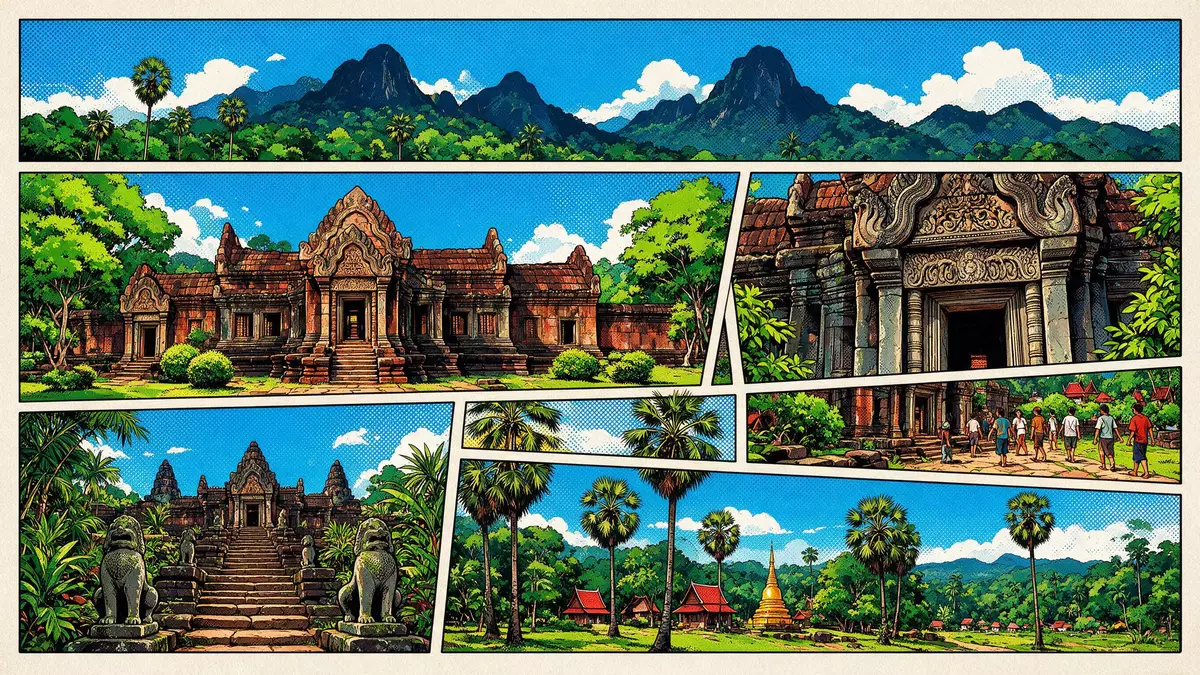
Wat Phou rises on the lower slopes of Phou Kao in Champasak, southern Laos. Its terraces, sandstone sanctuary and long axis belong to a planned landscape extending from mountain to Mekong River, where architecture and sacred terrain remain closely joined.
Wat Phou’s axis from Phou Kao to the Mekong
The temple complex forms part of the Champasak cultural landscape, a planned setting more than 1,000 years old. Its arrangement follows an axis between Phou Kao and the river, with temples, shrines, reservoirs and ancient settlements distributed across roughly 10 km. The landscape belongs to a development extending from the fifth to the fifteenth century, mainly associated with the Khmer Empire. Champasak cultural landscape
Phou Kao forms the mountain backdrop to the sanctuary. In Hindu tradition, the mountain was connected with Shiva, and the temple’s central alignment gives the visible landscape a religious setting that reaches beyond the surviving ruins.
Sandstone, laterite and brick on the sacred terraces
Most visible buildings belong to the eleventh to thirteenth centuries. Sandstone, laterite and brick appear together in the complex, including carved lintels, pediments, pillars, walls, courtyards and doorways. The materials change across the site, giving the ruins distinct textures and colours.
The approach passes through a ceremonial avenue and lower structures before reaching higher terraces. The upper sanctuary stands near a cliff and a natural spring. Its front section is made of sandstone, while the rear cella is brick. The surviving front area contains Buddha images, reflecting the Buddhist use of a complex that began within a Hindu religious setting. sandstone, laterite and brick
From Shiva sanctuary to Buddhist temple
Wat Phou’s history reaches back to the fifth century, while the principal remains visible on the terraces belong to the Khmer period. The site was connected with Shiva worship, and water from the spring was associated with the sanctuary’s sacred function.
By the thirteenth century, Buddhism had become the dominant religious tradition in the region. Buddha images occupy the sanctuary, and Buddhist practice continues to define the temple’s living religious identity. The ruins therefore preserve several layers of belief without losing the mountain, spring and river relationships that define the wider setting. Khmer Empire connection
Wat Phou was inscribed on the UNESCO World Heritage List in 2001 as part of “Vat Phou and Associated Ancient Settlements within the Champasak Cultural Landscape”. The designation includes the temple complex, ancient settlements beside the Mekong and Phou Kao itself. World Heritage inscription
Visiting Wat Phou: what travellers from Western Europe should know
- Wat Phou lies in Champasak, south of Pakse, near the Mekong River. Land routes from Pakse reach the temple, and the Mekong provides a further approach by boat.
- The complex climbs across terraces on the lower slopes of Phou Kao. Sandstone stairs, uneven surfaces and the ascent towards the sanctuary form part of the site’s physical character.
- The upper sanctuary stands beside a cliff and a natural spring. The route includes lower avenues, reservoirs, courtyards, carved stonework and elevated terraces.
- The official language is Lao and the currency is the Lao kip.
- Entry requirements depend on your nationality; UK travellers can check the FCDO travel advice at gov.uk/foreign-travel-advice, Irish travellers the Department of Foreign Affairs at ireland.ie.
Searching for Wat Phou on social platforms
These links open searches for Wat Phou on each platform.
Frequently asked questions about Wat Phou
Where is Wat Phou?
Wat Phou is in Champasak, southern Laos, on the lower slopes of Phou Kao near the Mekong River. Pakse is the main regional gateway.
What can visitors see at Wat Phou?
The complex includes a ceremonial avenue, reservoirs, terraces, courtyards, carved sandstone buildings, a cliffside spring and the upper sanctuary.
What makes Wat Phou distinctive?
Its Khmer architecture is arranged across a mountain-to-river cultural landscape. Hindu origins, Buddhist images and the sacred spring remain visible within the same setting.


