
Wat Phou and the sacred landscape of Champasak
Published on 08/22/2026 at 16:36 | Editorial responsibility: Rafael Müller, Editor-in-Chief AD HOC NEWS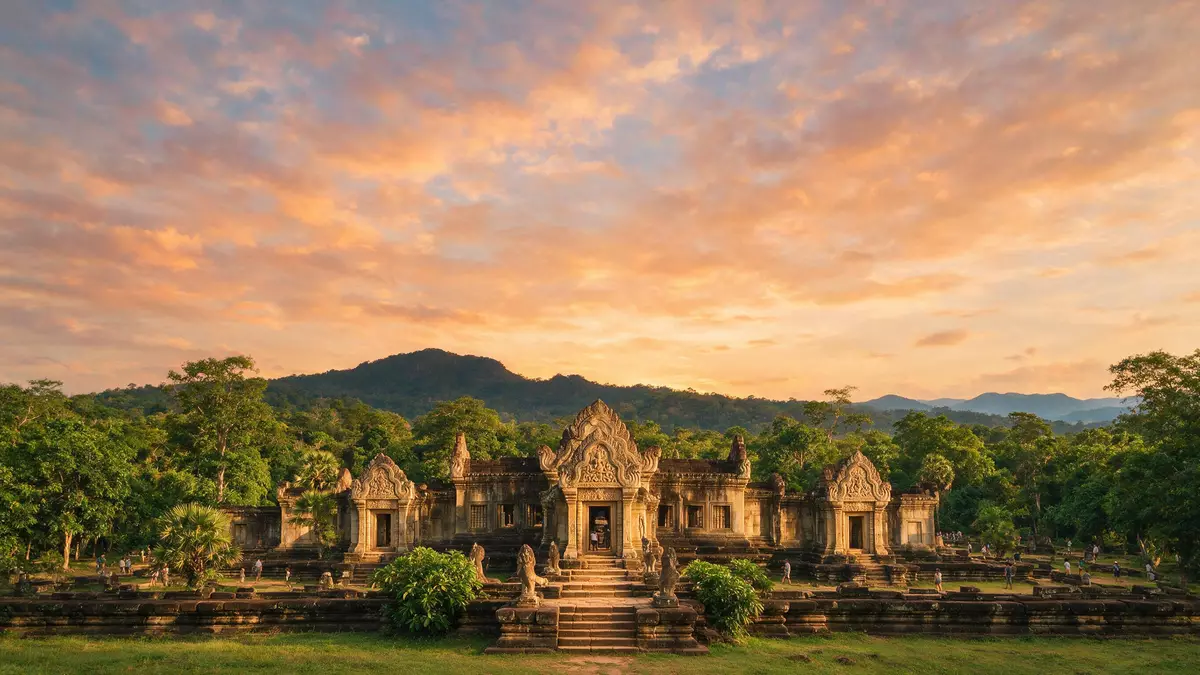
Wat Phou in Champasak, southern Laos, is a Khmer temple complex laid out along a long processional axis that climbs from the Mekong plain towards the slopes of Phou Khao, a mountain long regarded as sacred. The complex forms the heart of a broader cultural landscape that was inscribed on the UNESCO World Heritage List in 2001 as “Vat Phou and Associated Ancient Settlements within the Champasak Cultural Landscape”, recognising a planned ritual landscape more than 1,000 years in age.
A Khmer mountain temple above the Mekong
Wat Phou lies in Champasak Province in the south of Laos, close to the west bank of the Mekong River and framed by the distinctive outline of Phou Khao mountain rising above it.Champasak cultural landscape The temple complex occupies the lower slopes of the Pasak mountain range, with its processional way running roughly west to east between the river plain and the rocky hillside.axis linking Phou Khao and Mekong The setting lends the site a clear relationship between water, plain and mountain, with the sanctuary established where the slope steepens and natural rock appears among the structures.
The sacred character of Phou Khao is central to Wat Phou’s identity. In antiquity the mountain was known as Lingaparvata, associated with the lingam symbol of the Hindu god Shiva, and its summit was viewed as a holy place within the wider Khmer world.Lingaparvata sacred mountain The sanctuary at Wat Phou occupies a terrace high on the slope, at the end of the processional axis, and incorporates a spring that emerges from the hillside, emphasising the link between the temple, the mountain and flowing water.spring at the main sanctuary
Layers of history from Chenla to the Khmer Empire
The Champasak landscape around Wat Phou bears traces of occupation from at least the fifth century, when an early city known as Shrestapura stood on the plain and the area formed part of the Chenla kingdom.Shrestapura and Chenla Inscriptions from a ruler named Devanika attest to this early phase, during which the mountain and nearby river already held ritual importance for regional powers. Over time the focus of settlement shifted, and later cities were established further south within the same planned landscape.
The temple buildings visible at Wat Phou today largely date from the eleventh to thirteenth centuries, when the site formed part of the Khmer Empire that also produced the famous monuments of Angkor in present-day Cambodia.construction in the 11th to 13th centuries The complex developed along a carefully aligned east–west axis organised between the Mekong floodplain and the mountain, incorporating hydraulic structures, reservoirs and terraces framed by sandstone and laterite architecture.planned landscape with hydraulic works Earlier sanctuaries and waterworks from at least the ninth century formed predecessors to the present ensemble, which was consolidated during the reigns of Khmer rulers such as Suryavarman II.
Walking the processional way through the temple complex
Visitors approaching Wat Phou from the river plain encounter the remains of an extended processional route, laid out over more than 1 km and climbing steadily towards the main sanctuary on the hillside.processional axis over 1.4 km The route begins near the site of ancient cities in the alluvial plain and passes through a sequence of terraces bordered by stone-lined reservoirs that once served ritual and perhaps practical functions within the temple landscape.reservoirs and agricultural areas
Higher up the slope, the processional way reaches two substantial stone buildings often described as palaces, flanking the axis on either side and providing a dramatic architectural focus before the final climb.flanking palaces on the axis From this level, a steep staircase of many steps leads towards the main sanctuary terrace, where the principal shrine stands near the hillside spring. The combination of long axial approach, ritual reservoirs, flanking buildings and mountain sanctuary gives the walk through Wat Phou a clear progression from river plain to sacred height, with structures revealing different phases of Khmer architecture along the way.
Visiting Wat Phou: what travellers from Western Europe should know
- Wat Phou lies in Champasak Province in southern Laos, near the west bank of the Mekong River, and is reached from the nearby town of Champasak by road.
- The temple complex extends from the plain up the lower slopes of Phou Khao, and visiting the upper sanctuary involves ascending a long stone staircase with a significant gradient.
- The wider cultural landscape includes traces of ancient cities and agricultural areas on the alluvial plain, so exploring beyond the main sanctuary involves walking across uneven ground and low terraces.
- The official language is Lao and the currency is the Lao kip.
- Entry requirements depend on your nationality; UK travellers can check the FCDO travel advice at gov.uk/foreign-travel-advice, Irish travellers the Department of Foreign Affairs at ireland.ie.
Searching for Wat Phou on social platforms
These links open searches for Wat Phou on each platform.
Frequently asked questions about Wat Phou
Where is Wat Phou and what surrounds it?
Wat Phou is in Champasak Province in southern Laos, on the lower slopes of Phou Khao mountain near the west bank of the Mekong River, within a wider cultural landscape of ancient cities and agricultural areas.
What can visitors expect when exploring the site?
Visitors walk along a long axial route from the Mekong plain through terraces and reservoirs to stone buildings and a steep staircase that climbs to the main sanctuary beside a hillside spring.
What makes Wat Phou distinctive among temple sites?
Wat Phou is distinctive for its combination of Khmer temple architecture with a carefully planned landscape that links river, plain, reservoirs and mountain along a single ritual axis, recognised by UNESCO as a cultural landscape more than a millennium in age.


