
Wat Saket and the Golden Mount above old Bangkok
Published on 08/24/2026 at 08:41 | Editorial responsibility: Rafael Müller, Editor-in-Chief AD HOC NEWS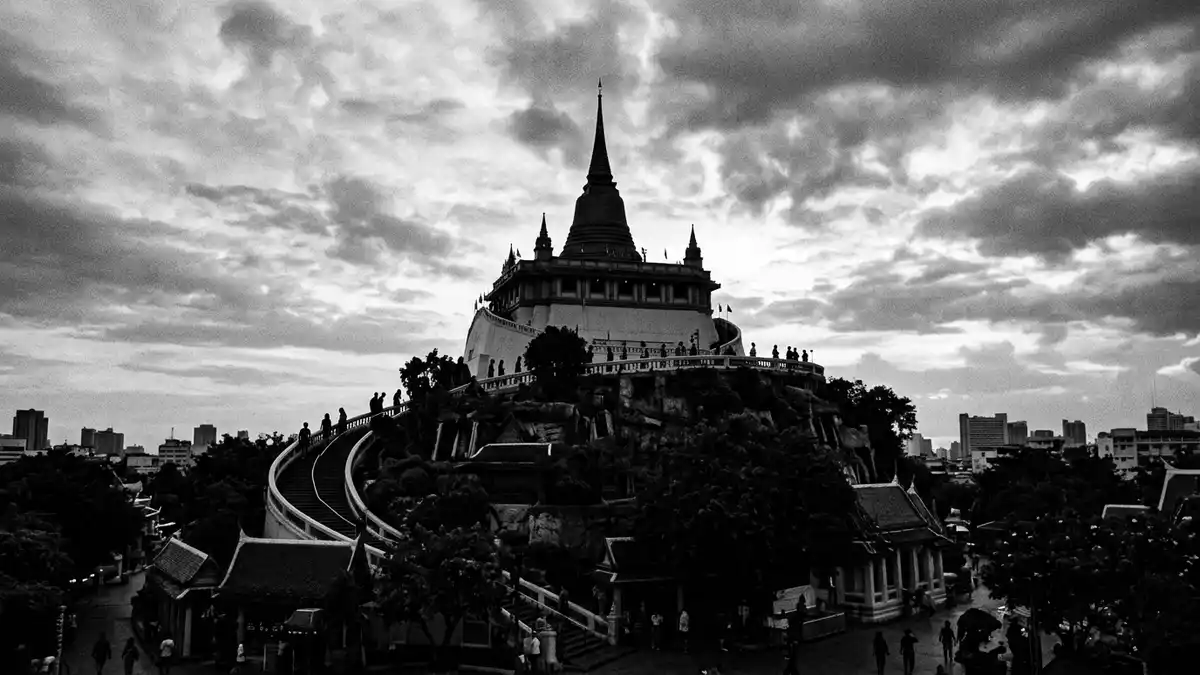
Wat Saket rises over Bangkok’s old city on an artificial hill known as the Golden Mount, where a gleaming stupa crowns a temple whose roots reach back to the Ayutthaya period and whose present form reflects the early Rattanakosin kings.
An Ayutthaya monastery in a new capital
Wat Saket began as a modest temple called Wat Sakae during the Ayutthaya era, when the Chao Phraya plain was dotted with monasteries serving local communities and river traffic.Wat Sakae in the Ayutthaya period When Bangkok became the capital in the late eighteenth century, King Rama I of the Chakri dynasty ordered the complex to be renovated and gave it the formal name Wat Saket Ratcha Wora Maha Wihan, establishing it as a royal temple within the new city.
The temple stands just outside the historic Rattanakosin island, in a district where monasteries, government buildings and canals mark the early layout of Bangkok.location outside Rattanakosin island Like many royal temples of the period, Wat Saket’s ordination hall, assembly spaces and monastic quarters follow traditional Thai forms with multi-tiered roofs, layered gables and bright coloured decoration set around courtyards and walkways.
The making of the Golden Mount
The Golden Mount, or Phu Khao Thong, is the feature that defines Wat Saket’s silhouette and sets it apart from other temples in Bangkok. During the reign of King Rama III in the nineteenth century, a large chedi was commissioned within the temple grounds, but the structure collapsed because the soft soil could not bear its weight, leaving a mound of bricks and earth that grew over with vegetation.collapsed chedi on soft ground
Later in the nineteenth century, under King Rama IV and King Rama V, the remains of the failed chedi were stabilised and built up into an artificial hill, reinforced first with timber and in the twentieth century with concrete, and a smaller gilded stupa was constructed at the summit containing relics of the Buddha brought from India.gilded stupa with relics Rising above the surrounding low-rise neighbourhoods, this hill was once among the highest points in Bangkok and remains a prominent landmark in the skyline of the old city.
Climbing the hill and exploring the temple
A visit to Wat Saket usually unfolds as a gradual ascent of the Golden Mount, following a staircase that spirals around the slope, passing shrines, bells and shady landings before reaching the terrace around the stupa. From the upper level, views open across the rooftops of Rattanakosin, nearby monuments and the line of the Chao Phraya River, giving a sense of how the temple once watched over a smaller city of canals and low houses.climb up the Golden Mount
At the base of the hill, the temple complex includes the main ordination hall with its Buddha image, subsidiary chapels and monastic buildings, reflecting a blend of Ayutthaya-era origins and later Rattanakosin embellishments.Wat Saket’s architectural blend The grounds also carry traces of the temple’s role as a cremation site in earlier centuries, when the poor and victims of disease were brought here for their last rites, adding a quieter layer of history beneath the hill that visitors climb.
Visiting Wat Saket: what travellers from Western Europe should know
- Wat Saket stands just east of key landmarks in Bangkok’s old city, near Bamrung Mueang Road and within reach of the Democracy Monument and the Phan Fa Lilat Bridge by road or local bus.
- The ascent of the Golden Mount involves a staircase with many steps that winds around the hill, so the approach requires steady footing and comfort with stair climbing in warm, humid conditions.
- The temple lies in Thailand, where the official language is Thai and the currency is the baht.
- Entry requirements depend on your nationality; UK travellers can check the FCDO travel advice at gov.uk/foreign-travel-advice, Irish travellers the Department of Foreign Affairs at ireland.ie.
Searching for Wat Saket on social platforms
These links open searches for Wat Saket on each platform.
Frequently asked questions about Wat Saket
Where is Wat Saket located in Bangkok?
Wat Saket stands in the old city area near Bamrung Mueang Road, close to the Democracy Monument and the Phan Fa Lilat Bridge on the eastern side of Rattanakosin.
What can visitors expect during a visit to Wat Saket?
Visitors encounter a traditional Thai temple complex combined with the climb up the Golden Mount, walking past shrines and bells to a terrace around a gilded stupa with wide city views.
What makes Wat Saket distinctive among Bangkok’s temples?
The temple’s Ayutthaya-era origins, renovation by King Rama I and the man-made Golden Mount with its Buddha relics together create a combination of hill, stupa and royal monastery unusual in Bangkok.


