
Westminster Abbey and the vertical story of British history
Published on 08/20/2026 at 06:49 | Editorial responsibility: Rafael Müller, Editor-in-Chief AD HOC NEWS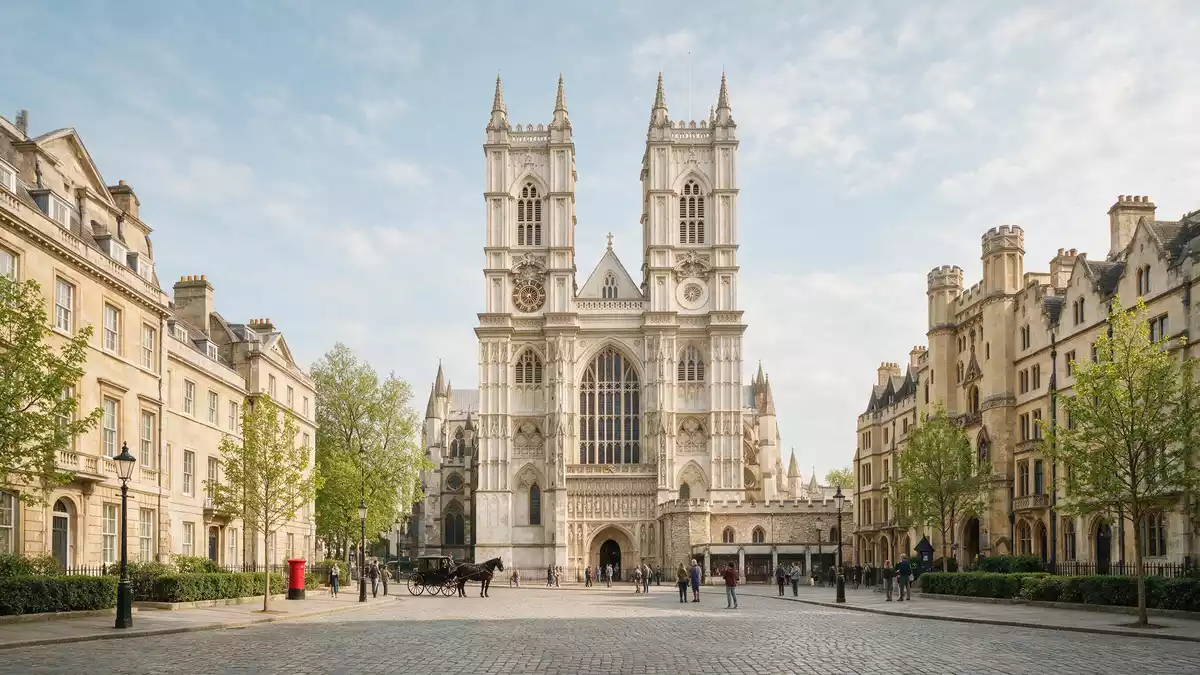
Westminster Abbey in London gathers nearly a thousand years of English and British history into a single Gothic church, rising beside the Palace of Westminster and Parliament Square. Built across the thirteenth to sixteenth centuries on the foundations of earlier monastic churches, it combines royal ceremony, national memory and intricate stonework in one compact space.
A Gothic church rebuilt for a medieval king
The origins of Westminster Abbey lie in a Benedictine monastery on Thorney Island in the Thames, with a major royal church attributed to Edward the Confessor and consecrated in 1065.Edward the Confessor’s church survived until the thirteenth century, when Henry III ordered a comprehensive rebuilding in the Gothic style that dominates the present structure.Henry III’s Gothic rebuilding Construction of the main body of the current church began in 1245, with work on the choir, transepts and eastern parts shaping its tall, slender interior.
The nave, where visitors first experience the full height of the church, was rebuilt in the later Middle Ages and extended into Tudor times, giving Westminster Abbey a layered architectural history in stone.Medieval nave rebuilding The building’s style is predominantly Gothic, with pointed arches, ribbed vaults and clustered columns forming vertical lines that draw the eye upward from the stone floor to the high vaults.Gothic architectural features
Royal ceremonies and a church of coronations
Westminster Abbey has been closely tied to the English and British monarchy for centuries, serving as the coronation church since the crowning of William the Conqueror in 1066.Coronation tradition since 1066 Monarchs have processed through the nave to the crossing for their anointing and crowning, making this interior the backdrop for one of the most formal rituals in British public life. Alongside coronations, the Abbey has hosted royal weddings and funerals, reinforcing its status as a stage for national events.
The building also holds the shrine of St Edward the Confessor, royal tombs and memorials to figures from politics, science, literature and the arts, with more than 3,000 people commemorated or buried there.Shrine and royal tombs In 1560, under Elizabeth I, the church was refounded as the Collegiate Church of St Peter in Westminster and became a royal peculiar, meaning it is a Church of England institution directly responsible to the sovereign rather than a bishop.Collegiate Church of St Peter This status continues to frame its role in both religious and ceremonial life.
Architecture in stone, glass and chapels
Architecturally, Westminster Abbey is an example of Geometric Gothic, using carefully cut Reigate stone for its main facings to create pale walls and articulated buttresses.Geometric Gothic style in Reigate stone Inside, the nave and choir are lined with stone piers that support ribbed vaulting, while stained glass windows admit coloured light into the tall interior. The layout is cruciform, with a central crossing dividing the long nave from the eastern choir and apse.
To the east of the main altar lies the Henry VII Lady Chapel, built in the early sixteenth century and known for its intricate fan vaulting and dense carving.Henry VII Lady Chapel The west front, framed by twin towers completed in the eighteenth century, gives Westminster Abbey a recognisable silhouette against the London skyline.West front and towers Within the cloisters and adjoining spaces, visitors find quieter courtyards, medieval stonework and access to the triforium level, reached by the modern Weston Tower.
Part of a UNESCO World Heritage ensemble
Westminster Abbey stands beside the Houses of Parliament and St Margaret’s Church in the Westminster district, forming a tight cluster of religious and political buildings around Parliament Square. Together with the Palace of Westminster and St Margaret’s, the Abbey is inscribed as a UNESCO World Heritage Site, recognising its architectural significance and its long association with British institutions.UNESCO World Heritage Site inscription
The Abbey’s setting places visitors within easy sight of Big Ben, the river Thames embankment and Whitehall, making it one of the central landmarks in London’s governmental quarter.Location in Westminster Stone façades, pinnacles and buttresses face onto streets carrying heavy traffic, yet within the precincts the cloister garth and Dean’s Yard retain a more enclosed character linked to the site’s monastic origins.Dean’s Yard address
Visiting Westminster Abbey: what travellers from Western Europe should know
- Westminster Abbey stands in central London beside the Palace of Westminster and Parliament Square, with nearby Underground stations at Westminster and St James’s Park on separate lines.
- Inside the church, movement between the nave, choir and side chapels involves walking on historic stone floors and negotiating steps, with narrow passages in places such as the cloisters and upper levels.
- The surroundings include Parliament Square, the Thames embankment and the government buildings of Whitehall, bringing together major civic landmarks within short walking distance.
- The official language is English and the national currency is the pound sterling.
Searching for Westminster Abbey on social platforms
These links open searches for Westminster Abbey on each platform.
Frequently asked questions about Westminster Abbey
Where is Westminster Abbey in London?
Westminster Abbey stands beside the Palace of Westminster and Parliament Square in the Westminster district of central London, close to the river Thames and Big Ben.
What can visitors expect inside Westminster Abbey?
Visitors encounter a tall Gothic nave, side chapels including the Henry VII Lady Chapel, royal tombs, memorials and cloister walks that reflect the church’s monastic and ceremonial past.
What makes Westminster Abbey distinctive among London churches?
Its role as the coronation church since 1066, its status as a royal peculiar and its inclusion in a UNESCO World Heritage Site with the Palace of Westminster give it a rare combination of religious, architectural and national significance.


