
Westminster Abbey’s Gothic layers in London
Published on 08/23/2026 at 13:09 | Editorial responsibility: Rafael Müller, Editor-in-Chief AD HOC NEWS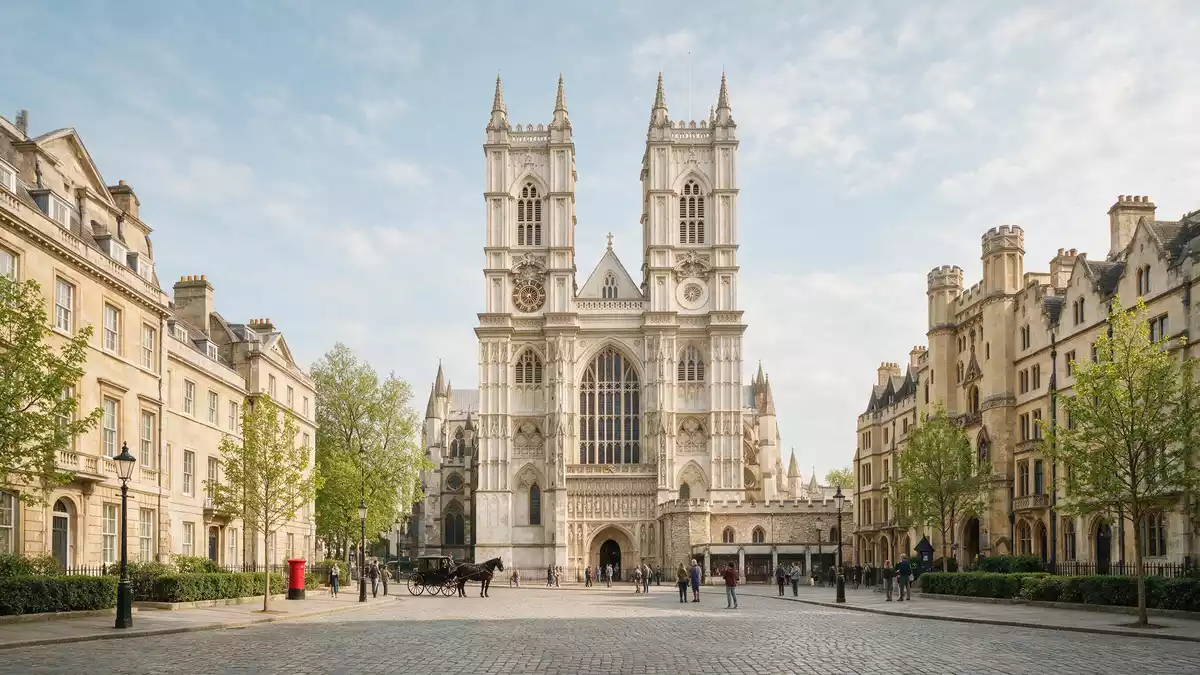
Westminster Abbey in London is a Gothic church with a long, layered history, and its stonework still carries that sequence in plain view. The present church began in 1245 under Henry III, and it stands within the Palace of Westminster World Heritage site.
Henry III’s Gothic rebuilding
The abbey’s present form belongs to the thirteenth century, when Henry III ordered a major rebuilding of the church. The result is a great Gothic structure, with a choir, transepts and a long nave that belong to different phases of work.
Its best-known association is coronation. Since 1066, English and later British monarchs have been crowned here, and the building remains a royal peculiar under the Church of England.
Henry III also tied the rebuilding to the shrine of Edward the Confessor, whose burial place remains central to the abbey’s identity.
Stone, vaults and later additions
The abbey’s fabric mixes medieval Gothic work with later additions, and that mixture is visible across the exterior and interior. The World Heritage site description places it beside the River Thames in central London, with the abbey forming one element of a wider historic ensemble.
The building’s development continued into the sixteenth century, and later work added to the medieval core rather than replacing it. That layered survival gives the abbey its dense reading of English church architecture across several centuries.
Its status as a UNESCO World Heritage site underlines that historic and symbolic value, shared with the Palace of Westminster and St Margaret’s Church.
A church of kings, graves and memory
Westminster Abbey is also a place of burial and remembrance, not only ceremony. The church contains the tomb of Edward the Confessor and many royal and national memorials, making it both a working church and a historical archive in stone.
The building’s role has remained religious as well as ceremonial. Regular worship continues alongside major state occasions, and that dual use helps explain why the abbey feels less like a preserved relic than a living monument.
Visiting Westminster Abbey: what travellers from Western Europe should know
- The abbey stands in Dean’s Yard, near the Palace of Westminster and the River Thames. Westminster station and St James’s Park station are the nearest Underground stations.
- Access inside includes stairways and substantial medieval masonry. The interior also includes tall vaults, a long nave and side chapels that extend through the church.
- The official language is English and the currency is the British pound.
- The abbey is part of a larger World Heritage site with the Palace of Westminster and St Margaret’s Church.
Searching for Westminster Abbey on social platforms
These links open searches for Westminster Abbey on each platform.
Frequently asked questions about Westminster Abbey
Where is Westminster Abbey?
It stands in central London, close to the River Thames and the Palace of Westminster.
What is a visit to Westminster Abbey like?
The abbey is a large Gothic church with a long nave, side chapels and a richly layered interior. It also remains a functioning church with royal and national associations.
What makes Westminster Abbey distinctive?
Its strongest features are the coronation tradition, the thirteenth-century rebuilding under Henry III and its place within a UNESCO World Heritage site.


