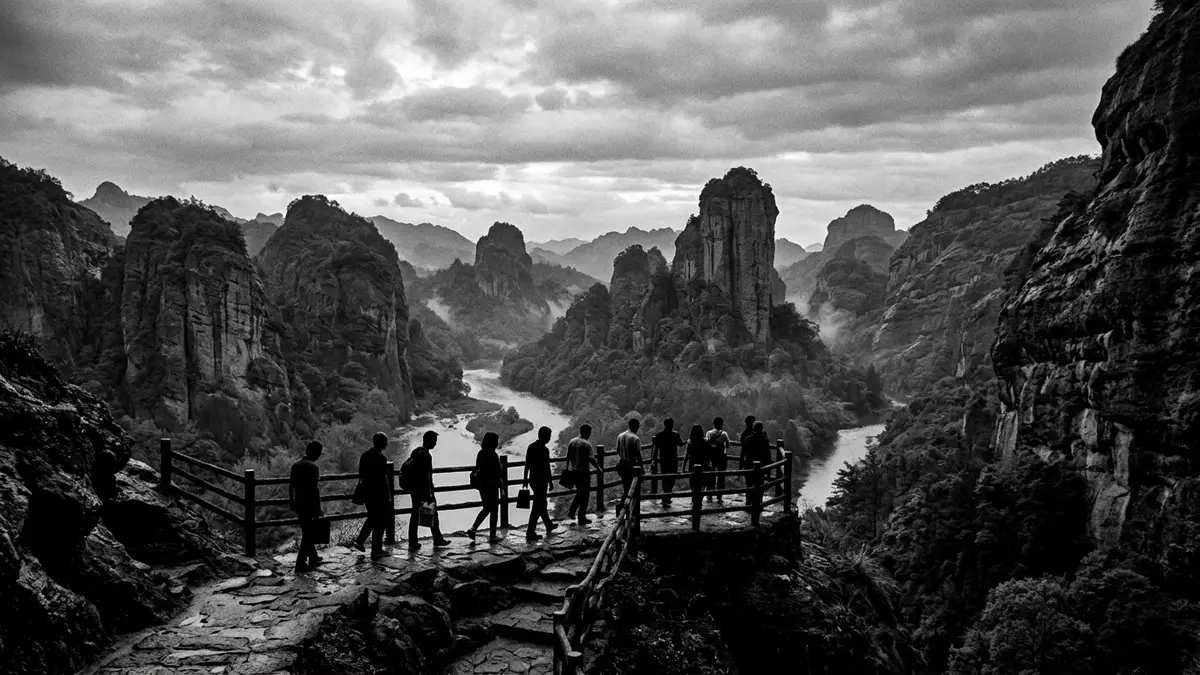
Wuyi Shan’s cliffside tea country in northern Fujian
Published on 08/06/2026 at 16:57 | Editorial responsibility: Rafael Müller, Editor-in-Chief AD HOC NEWS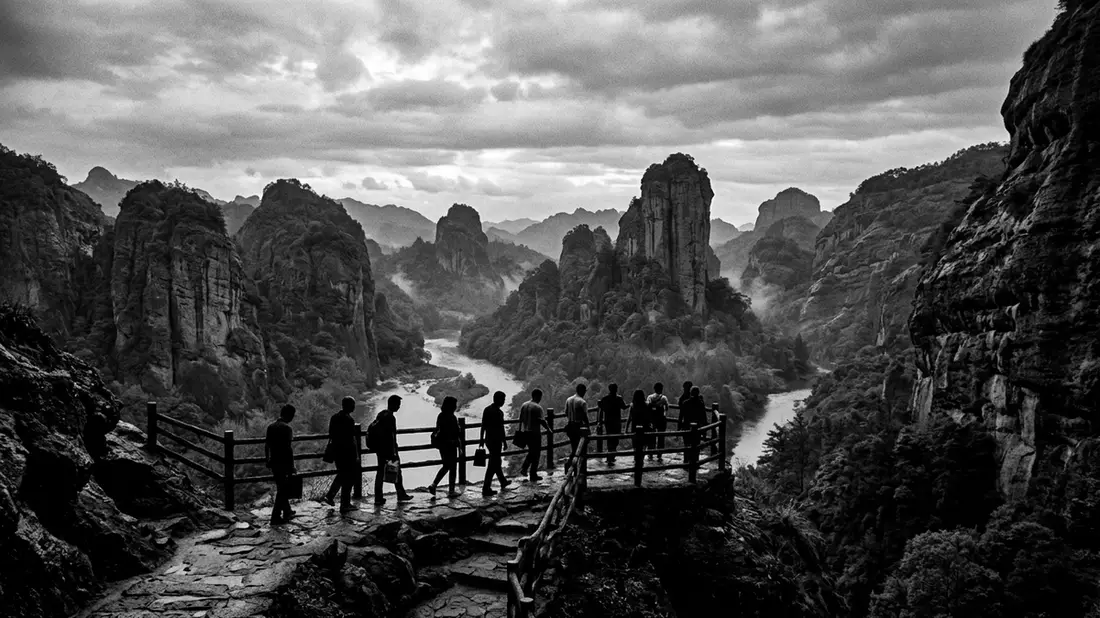
Wuyi Shan’s sandstone labyrinth
Wuyi Shan in northern Fujian, reached from Nanping, is a mountain and river landscape carved into layered sandstone and conglomerate rock. The massif rises in a series of sheer cliffs and flat-topped peaks, with warm reddish tones on exposed faces and darker streaks where water has seeped and stained the stone over time. Narrow gorges cut deep into the plateau, creating a kind of natural labyrinth where steep walls, winding channels and sudden rock pillars define each turn in the valley.
The core scenic area is structured by one main river that threads between the cliffs, looping past stacked rock towers and steep, forested slopes. Along its banks, terraces hold tea bushes in orderly rows, stepping down towards the water in tight scallops of cultivated green. Above them, the rock stands almost vertical, so the view often combines three clear layers: dark river at the base, patterned tea in the middle, and pale cliff crowned with woodland at the top. Footpaths follow this relief, sometimes hugging the riverbank, sometimes climbing through bamboo stands and mixed forest to vantage points on the plateau.
Tea terraces and the culture of cliff-grown leaves
Wuyi Shan is closely associated with rock-grown tea, a style of oolong that takes its character from the thin soils and fractured stone of the slopes. Tea gardens here are frequently cut into terraces directly above cliffs or in small basins between buttresses of rock, so the plants grow in a patchwork that follows the natural shape of the mountains rather than a regular grid. Many of the more established tea plots sit on ledges where the soil is well drained, forcing the roots to work into cracks in the bedrock. This setting produces plants that can tolerate strong sun and cooler air moving down the ravines.
Over generations, growers around Wuyi Shan have learned to work with this demanding terrain. Paths in the tea gardens tend to be narrow and sometimes uneven, marked by flat stones and packed earth rather than wide farm tracks. Small shelters and work sheds stand on marginal ground near the terraces, often built of brick or rendered concrete with tiled roofs that echo the colours of traditional southern Chinese houses. Visiting the tea areas is a way of understanding how people have adapted to steep slopes and thin soils, using hand tools, careful pruning and selective planting to turn fractured rock into productive land.
Temples, inscriptions and the river between cliffs
Human traces in Wuyi Shan often appear where cliffs give way to more gentle slopes or where caves notch into the rock. There are temples and shrines built in these transitional zones, many with dark timber halls, carved eaves and painted beams. Some complexes sit directly against a cliff, their roofs almost brushing the rock face, while others stand above the river on small shoulders of land where steps lead up from the water’s edge. The setting means that incense smoke, bell sounds and wooden doors are framed by stone walls and forest, giving religious spaces a tight relationship with the surrounding geography.
Cliff inscriptions add another layer of culture to the landscape. On certain faces near the river or along main paths, large Chinese characters have been cut or painted onto the rock, often using red pigment that stands out against the pale stone. These inscriptions sit high above ground level, sometimes near natural ledges, sometimes in apparently inaccessible positions, reinforcing the sense that the cliffs themselves carry writing and memory. When travelling by boat along the river, the sequence of inscriptions, ridges and bends turns the journey into a procession of named viewpoints and historical references anchored literally in stone.
Visiting Wuyi Shan: what travellers from Western Europe should know
- Wuyi Shan lies in northern Fujian province in China and is commonly reached by domestic flight or rail to Nanping or a nearby city, then by road into the scenic area.
- Admission arrangements and opening hours are set by the site's operator and change with the season; the official website is the only binding source. Timed tickets or daily limits may apply, so it is worth checking the official booking page before travelling.
- The region can be hot and humid in summer and cooler in winter, with spring and autumn often offering milder temperatures and clearer air along the cliffs and rivers.
- Many routes in Wuyi Shan involve stone steps, uneven forest paths and riverbank walks, so sturdy footwear is advisable and travellers should be prepared for sustained walking on gradients.
- Mandarin Chinese is the main language and cashless payment is widespread, though carrying some cash can be useful; basic courtesy such as greeting tea growers and temple staff politely is appreciated, and restrictions may apply on site.
- Entry requirements depend on your nationality. UK travellers should check the FCDO travel advice at gov.uk/foreign-travel-advice; Irish travellers the Department of Foreign Affairs at ireland.ie; EU and EEA citizens their own national foreign ministry.
Searching for Wuyi Shan on social platforms
Travellers interested in Wuyi Shan often explore visual impressions of its cliffs, river journeys and tea terraces through video and photo-sharing platforms before planning a visit.
Frequently asked questions about Wuyi Shan
Where is Wuyi Shan and how does it relate to Nanping?
Wuyi Shan is a mountain and river landscape in northern Fujian province in China, with access routes commonly organised through the wider Nanping area.
What should visitors expect on a typical day in Wuyi Shan?
Visitors can expect walks along rivers and through forest, climbs on stone steps to viewpoints, and close contact with tea terraces and temple sites framed by cliffs.
What makes Wuyi Shan distinctive among mountain landscapes?
Wuyi Shan stands out for its combination of sheer sandstone cliffs, a winding river corridor, cliff-grown tea gardens and cultural sites that are tightly embedded in the rock landscape.
More on Wuyi Shan at AD HOC NEWS