
Xi Hu and the layered landscape of Hangzhou
Published on 09/24/2026 at 04:16 | Editorial responsibility: Rafael Müller, Editor-in-Chief AD HOC NEWS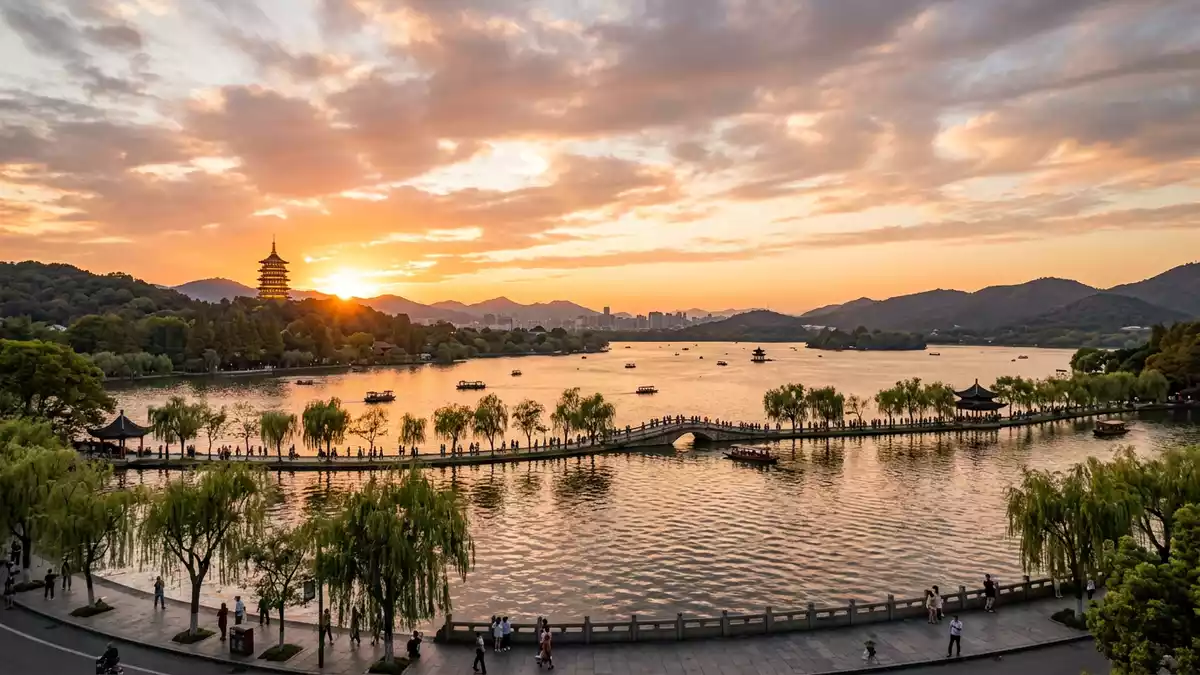
Xi Hu, known in English as West Lake, is a freshwater lake in Hangzhou, China. Its visible character comes from the meeting of open water, wooded hills, causeways, islands, gardens and historic buildings, assembled across centuries.
Xi Hu between city and cloud-capped hills
The lake lies west of Hangzhou’s former walled city. Hills surround three sides, while the urban fabric occupies the fourth, creating a clear relationship between water and city.
Xi Hu covers just over 6 km² and extends about 3.2 km from north to south and 2.8 km from east to west. Its shoreline, paths and viewpoints connect water with temples, pavilions, bridges and planted slopes.
Causeways, islands and the making of a cultural landscape
The lake’s most recognisable built features are its causeways and artificial islands. Repeated dredging between the ninth and twelfth centuries produced major landscape elements that divide the water into distinct spaces.
Temples, pagodas, pavilions, gardens and ornamental trees form part of the wider setting. Their arrangement belongs to a Chinese landscape tradition in which water, vegetation, architecture and distant hills appear together in composed views.
West Lake Cultural Landscape has been associated with poets, scholars and artists since the Tang dynasty. The site entered the UNESCO World Heritage List in 2011.
From Tang poetry to UNESCO heritage
Xi Hu’s cultural identity reaches back to the Tang dynasty, whose dates run from AD 618 to 907. Writers and artists connected the lake with named views, seasonal images and ideals of landscape composition.
During the Southern Song dynasty, ten poetically named scenic places became a recognised way of presenting the lake. The tradition joined literary description with physical locations around the water.
The protected cultural landscape includes the lake and its surrounding hills, together with historic structures, gardens, causeways and islands. Its recorded heritage area covers 3,322.88 hectares, while the lake itself occupies a smaller part of that setting.
The Hangzhou cultural landscape brings natural features and constructed elements into one named heritage property. Xi Hu is therefore more than a body of freshwater; it is the central water element of a historic landscape.
Visiting Xi Hu: what travellers from Western Europe should know
- Xi Hu lies in Hangzhou’s Xihu District, west of the former city centre. Hangzhou’s public buses, railway services and urban roads connect the lake with the wider city.
- The shoreline includes level promenades, bridges, causeways and paths rising towards the surrounding hills. Walks can therefore range from flat lakeside stretches to sloping routes and steps.
- The official language is Mandarin Chinese and the currency is the Chinese yuan.
- Xi Hu’s landscape includes water, planted shores, wooded hills, historic buildings and artificial islands. A single lakeside outing can therefore combine urban views with garden and temple scenery.
Searching for Xi Hu on social platforms
These links open searches for Xi Hu on each platform.
Frequently asked questions about Xi Hu
Where is Xi Hu?
Xi Hu is in Hangzhou, Zhejiang province, China. The lake lies west of the former walled city, in the district that bears its name.
What can visitors see around the lake?
The setting includes causeways, artificial islands, gardens, temples, pagodas, pavilions, bridges and wooded hills. The lakeshore combines open water with historic and planted landscapes.
What makes Xi Hu distinctive?
Xi Hu is the central feature of a UNESCO cultural landscape inscribed in 2011. Its identity rests on the visible relationship between water, city, hills and constructed scenery.


