
Yiheyuan and the landscape of imperial Peking
Published on 09/22/2026 at 13:40 | Editorial responsibility: Rafael Müller, Editor-in-Chief AD HOC NEWS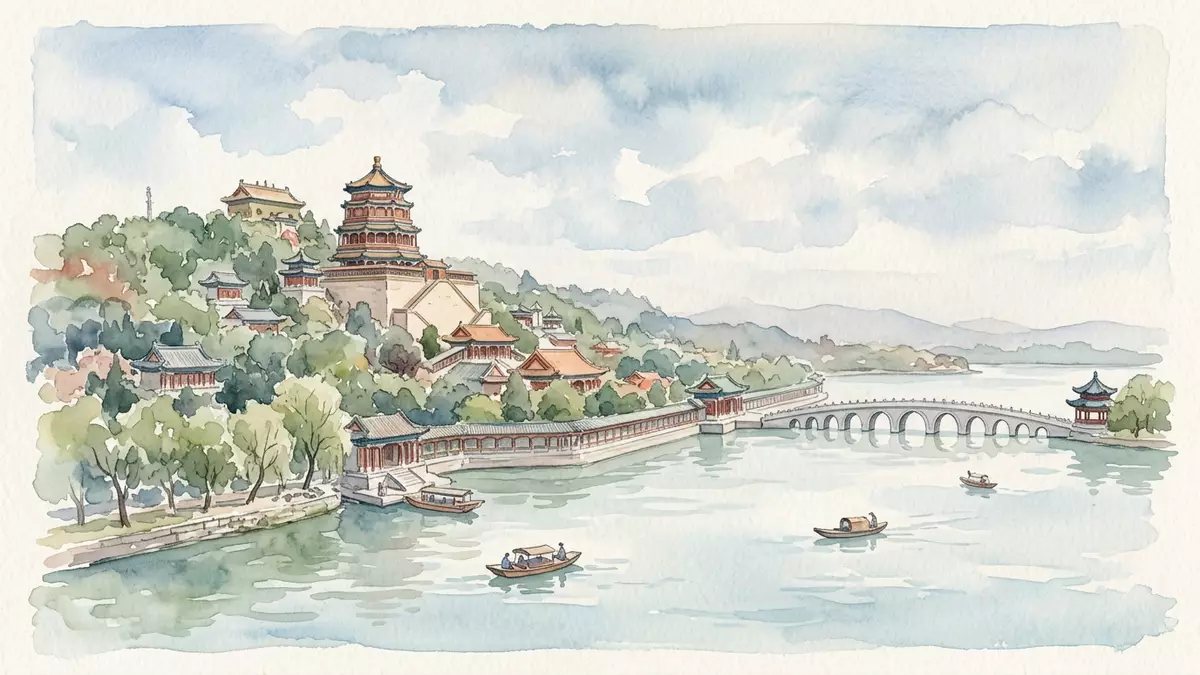
Yiheyuan, the Summer Palace of Peking, is an imperial garden arranged around Kunming Lake and Longevity Hill. Water, wooded slopes, bridges, halls and pavilions form a landscape in which architecture occupies the shore, the hillside and the lake itself.
The garden carries the name Yiheyuan, meaning the Garden of Nurtured Harmony, and its surviving form belongs chiefly to the Qing dynasty. Its buildings and waterways present a connected composition rather than a single palace standing apart from its setting.
Yiheyuan: a palace spread across water and hillside
Kunming Lake occupies much of the garden, with Longevity Hill rising along its northern shore. The arrangement joins broad water, elevated ground and built structures within one enclosed imperial landscape.
Long covered galleries run beside the lake, while halls and pavilions occupy the slopes above them. Bridges cross the water, and islands sit within the lake as architectural parts of the garden rather than detached scenery. the lake and hillside plan records the garden’s close relationship between water and land.
From Qing imperial garden to Yiheyuan
The Qing Qianlong emperor commissioned the principal eighteenth-century garden in 1750. It was completed in 1764 as the Garden of Clear Ripples, before acquiring the name Yiheyuan in 1888.
The site has older layers. Gardens and imperial facilities existed around the western hills of Peking before Qianlong’s project, while the lake formed part of the region’s water landscape during earlier dynasties. the Qing garden’s dates place its principal composition within the period from 1750 to 1764.
War damaged the garden in 1860. Empress Dowager Cixi oversaw its reconstruction in the late nineteenth century, and the restored complex became closely associated with her residence and court life. The buildings therefore carry both the refinement of Qing garden design and the marks of imperial political history.
Halls, galleries and the grammar of Chinese garden design
The architecture of Yiheyuan includes ceremonial halls, domestic quarters, religious buildings, gateways and waterside structures. Roofs carry glazed tiles, timber frames support painted interiors, and carved stone bridges connect parts of the grounds.
The Long Corridor follows the northern edge of Kunming Lake and links views of water, hill and architecture. Its painted beams contain scenes from Chinese history, literature and landscape painting, making the gallery both a covered passage and a decorated architectural work.
At the centre of the hill stands the ensemble around the Tower of Buddhist?? Faith. The name is commonly rendered as the Tower of Buddhist Incense, and its layered rooflines form the most recognisable vertical group in the garden. Below it, halls face the lake and terraces descend towards the water.
Yiheyuan became a public park after the end of the imperial system. UNESCO added the Summer Palace to the World Heritage List in 1998, recognising its landscape-garden composition and the relationship between natural features and architecture. its World Heritage status is part of the site’s formal identity.
Visiting Yiheyuan: what travellers from Western Europe should know
- Yiheyuan lies in Haidian District, north-west of central Peking. Beijing Subway Line 4 serves Beigongmen and Xiyuan stations near different entrances.
- The grounds combine level lakeside paths with stairways on Longevity Hill. Reaching the upper halls involves uneven stone surfaces and climbing.
- The lake is crossed by bridges and bordered by the Long Corridor. Kunming Lake and Longevity Hill remain the two defining landscape features.
- The official language is Mandarin Chinese and the currency is the renminbi.
- Entry requirements depend on your nationality; UK travellers can check the FCDO travel advice at gov.uk/foreign-travel-advice, Irish travellers the Department of Foreign Affairs at ireland.ie.
Searching for Yiheyuan on social platforms
These links open searches for Yiheyuan on each platform.
Frequently asked questions about Yiheyuan
Where is Yiheyuan?
Yiheyuan is in Haidian District in north-western Peking. Its grounds extend around Kunming Lake and the southern side of Longevity Hill.
What can visitors expect to see?
The garden contains imperial halls, painted galleries, bridges, pavilions, temples, wooded slopes and extensive water scenery. The Long Corridor and the hilltop Tower of Buddhist Incense are prominent features.
What makes Yiheyuan distinctive?
Yiheyuan combines a large lake, a mountain-like hill and Qing imperial architecture in one designed landscape. Its principal garden composition dates from the eighteenth century and its World Heritage designation dates from 1998.


