
Yokohama Chukagai and its gates, temples and port-city history
Published on 09/23/2026 at 18:47 | Editorial responsibility: Rafael Müller, Editor-in-Chief AD HOC NEWS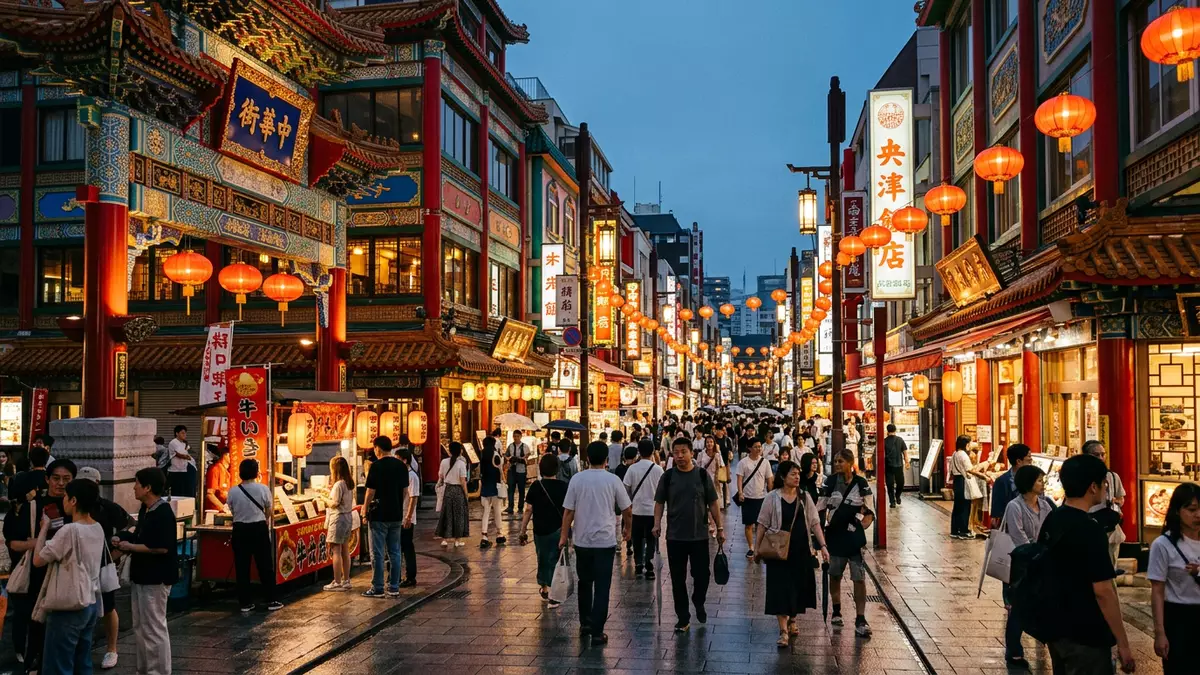
Yokohama Chukagai is a Chinese cultural quarter beside Yokohama’s historic harbour. Its streets are framed by decorated gates, while temples, restaurants and shops reflect a community that took shape after Yokohama opened to international trade in 1859.
The district is read through its entrances as much as its buildings. Colourful pailou gates mark the surrounding streets, and Kanteibyo temple provides a vivid religious centre within the commercial neighbourhood.
Yokohama Chukagai begins with the opened port
Yokohama became an international port in 1859, during the final years of the Edo period. Chinese traders, interpreters and merchants arrived alongside foreign businesses, settling near the harbour and forming institutions for community life.
The early district included shops, places of worship, a school and an assembly hall. Its development belongs to the wider history of Yokohama as a treaty port, where maritime trade connected Japan with cities including Canton, Hong Kong and Shanghai. The port’s opening provides the historical anchor for Yokohama Chukagai’s origins.
The Great Kanto Earthquake of 1923 damaged much of Yokohama and destroyed buildings in the Chinese quarter. War and reconstruction altered the district’s physical fabric, while its cultural institutions continued to shape its identity.
Yokohama Chukagai received official recognition under that name in 1955. The date connects the quarter’s nineteenth-century beginnings with its established place in Yokohama’s urban history.
The gates give the quarter its visible rhythm
Decorated gates stand at the principal approaches and within the neighbourhood. Four major gates correspond with the cardinal directions in Chinese tradition: Choyomon to the east, Suzakumon to the south, Enpeimon to the west and Genbumon to the north.
Each gate has its own name, colour scheme and guardian figure. The eastern gate is associated with the Azure Dragon, the southern gate with Suzaku, the western gate with the White Tiger, and the northern gate with Genbu.
The gates are pailou-style structures, with layered roofs, strong colours and ornamental details. They turn the boundaries of the district into recognisable architectural markers instead of leaving the quarter as an unnamed stretch of city street.
Zenrinmon, the Good Neighbor Gate, stands at an entrance to Chukagai Odori. Built in 1955, it belongs to the period when the district acquired its official name and its modern public identity. The quarter’s network of gates is described in detail through the four directional gates.
Seen together, the gates create a sequence of entrances, junctions and internal markers. Their forms refer to Chinese architectural traditions, while their position inside Yokohama makes them part of the city’s port landscape.
Kanteibyo and Masobyo anchor religious life
Kanteibyo is dedicated to Guan Yu, a military figure from China’s Three Kingdoms period who became associated with business, prosperity and loyalty. A small shrine existed by 1862, and the Chinese community established a temple in the nineteenth century.
The temple’s exterior combines vivid colours, carved decoration, roof forms and guardian lions. It stands among shops and restaurants, placing a religious building directly within the everyday movement of the quarter.
Kanteibyo was damaged during the Great Kanto Earthquake and has been rebuilt after destruction. Its history therefore includes both the continuity of worship and the repeated reconstruction that marked Yokohama during the twentieth century. The temple’s nineteenth-century foundation is recorded in the history of Kanteibyo.
Masobyo, also called Yokohama Mazu Miao, was established in 2006. It is dedicated to Mazu, a sea goddess associated with sailors, travellers and maritime communities.
The two temples present different layers of the district’s religious landscape. Kanteibyo reaches back to the nineteenth-century settlement, while Masobyo belongs to the neighbourhood’s twenty-first-century form. Together, they connect Chinese religious traditions with Yokohama’s relationship to the sea.
Food culture occupies much of the surrounding streets. Restaurants, bakeries, tea shops and food counters make the quarter a commercial district as well as a place of worship. Menus and shopfronts provide a visible expression of the Chinese, Japanese and wider Asian connections carried by the port city.
Visiting Yokohama Chukagai: what travellers from Western Europe should know
- Yokohama Chukagai lies in central Yokohama near Yamashita Park and the harbour. The Minatomirai Line reaches Motomachi-Chukagai Station, while Ishikawacho Station is served by the JR Negishi and Keihin-Tohoku lines.
- The district is an urban street neighbourhood, with temples, gates, restaurants and shops distributed through a compact network of streets. The main approaches include Chukagai Odori and the streets around the directional gates.
- Yokohama Park and Yokohama Stadium lie near the northern side of the quarter. Motomachi and Yamashita Park are also within the surrounding central Yokohama area.
- The official language is Japanese and the currency is the Japanese yen.
Searching for Yokohama Chukagai on social platforms
These links open searches for Yokohama Chukagai on each platform.
Frequently asked questions about Yokohama Chukagai
Where is Yokohama Chukagai?
Yokohama Chukagai is in central Yokohama, close to Yamashita Park, Yokohama Park and the harbour. Motomachi-Chukagai and Ishikawacho are the principal nearby railway stations.
What can visitors expect in the district?
The quarter contains decorated gates, Chinese temples, restaurants, food shops and commercial streets. Kanteibyo and Masobyo provide two distinct religious landmarks within the neighbourhood.
What makes Yokohama Chukagai distinctive?
Its identity combines a Chinese community established after the port opened in 1859 with a network of directional gates and temples. The name Yokohama Chukagai was officially recognised in 1955.


