
Zona Arqueologica de Tulum and its walled cliffside city
Published on 08/20/2026 at 15:22 | Editorial responsibility: Rafael Müller, Editor-in-Chief AD HOC NEWS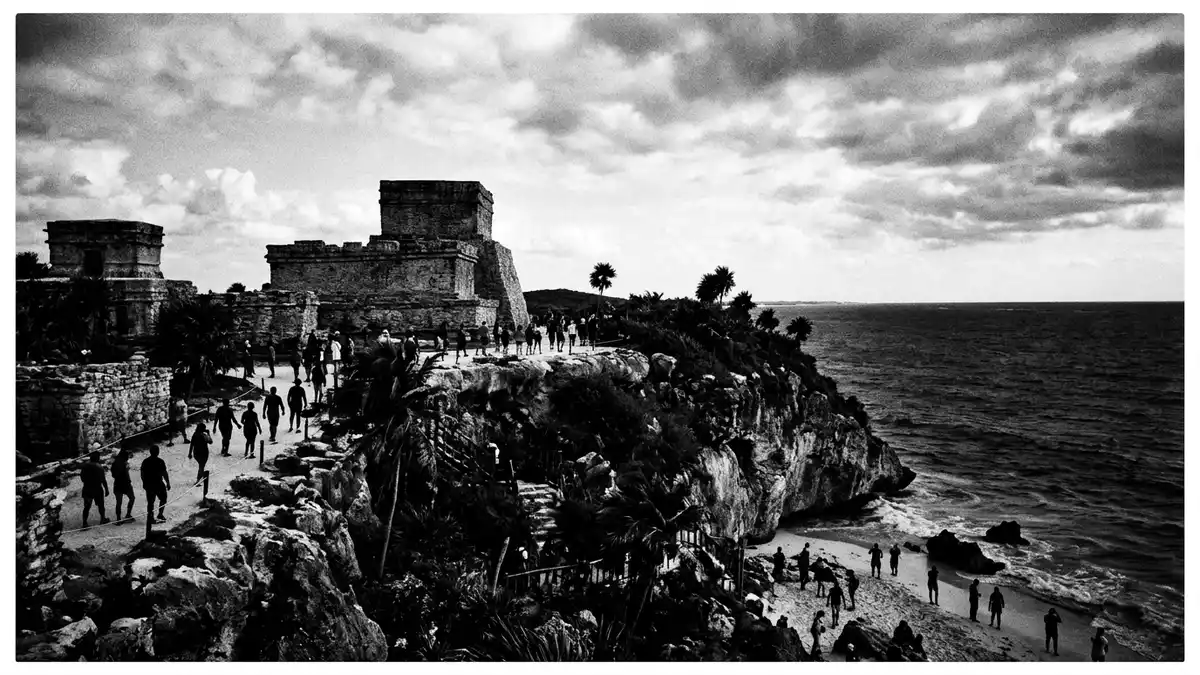
Zona Arqueologica de Tulum is a compact Maya walled city set on cliffs above the Caribbean Sea at the edge of Tulum in eastern Mexico, where stone architecture and coastal landscape meet directly. The site preserves late pre?Columbian structures from the post?classic period alongside a defensive wall and sea views that define its character.
A late Maya port city on the Caribbean coast
Zona Arqueologica de Tulum occupies a stretch of coastline on the Caribbean Sea in Quintana Roo, Mexico, where the Yucatán Peninsula meets the open water. The ruins stand north of Tulum town, above a narrow beach, and are laid out as a compact urban core with temples, platforms and palaces grouped on slightly rising ground inside a walled enclosure.Tulum in Quintana Roo The archaeological zone represents a post?classic Maya city that functioned as a coastal centre and trading port between about 1,200 and the early sixteenth century, when Spanish incursions reached the region.post?classic Maya city
The name “Tulum” derives from a Yucatec Maya word for “wall” or “fence”, a reference to the masonry defences that frame the city on landward sides while the cliffs and sea define the fourth edge.meaning of Tulum Archaeological work links the standing buildings to the Middle and Late Postclassic, roughly between the thirteenth and fifteenth centuries, with earlier elements such as Stela 1 pointing to deeper roots in the sixth century.Middle and Late Postclassic The site belongs to the East Coast architectural tradition of the Maya area, distinguished by flat roofs supported on columns and miniature temples rather than the high vaulted interiors of inland centres.
Walls, layout and East Coast architecture
Zona Arqueologica de Tulum is enclosed on three sides by fortification walls built of local limestone, separating the ceremonial and residential core from the surrounding terrain.limestone wall These walls are several metres thick and rise to a height comparable with the main platforms inside, punctuated by gateways that once controlled movement between the interior and the wider coastal route. Together with the cliffs, they frame a rectangular area within which the principal buildings stand, including temples aligned along central pathways and smaller structures scattered toward the edges.map of the archaeological zone
The architecture inside the enclosure follows the East Coast style described by Mexican heritage authorities, with flat roofs, colonnaded facades and smaller shrines embedded inside larger buildings.East Coast style Many structures are built on stepped platforms, with temples at the top approached by stairways. Surfaces that now read as bare stone were once coated in stucco and painted; traces of red pigment and fragments of mural decoration survive in places, especially in one key building discussed below. Columns support roof slabs rather than true corbelled vaults, and smaller annexes, shrines and subsidiary chambers cluster around larger halls, giving the site a textured, layered silhouette.
El Castillo, the Temple of the Frescoes and the Descending God
Several named structures at Zona Arqueologica de Tulum organise any visit and convey much of the site’s character. The most prominent is El Castillo, “the Castle”, a masonry mass rising on a platform close to the cliff edge above the Caribbean.El Castillo El Castillo stands on a limestone outcrop approximately 12 m (about 39 ft) above the sea and forms the tallest structure in the enclosed city, with a temple on its summit and steps leading to the upper level.height of El Castillo The building is positioned so that its mass appears directly against the horizon of the Caribbean when seen from the interior, and it has long attracted attention for its combination of religious functions and navigational alignment.
Near El Castillo, the Temple of the Frescoes preserves some of the best?known painted murals from the Maya area. This two?storey structure was used as an observatory and features interior wall paintings with cosmological and deity imagery, including figures linked to rain and agriculture.Temple of the Frescoes The murals, protected inside the building, retain visible colour and detail even after centuries. Another key building, the Temple of the Descending God, is named for a head?first figure carved over its doorway, representing a deity associated in scholarship with Venus, bees or the sun’s cycle.Temple of the Descending God Depictions of this descending figure appear in several places around the site, underlining its importance in local religious practice.
Visiting Zona Arqueologica de Tulum: what travellers from Western Europe should know
- Zona Arqueologica de Tulum lies just north of Tulum town in Quintana Roo on Mexico’s Caribbean coast, reached by road along Highway 307, which connects Cancún and other Riviera Maya centres.
- The archaeological zone stands on limestone cliffs and slightly rising ground; paths cross uneven rock and low steps, and some viewpoints near El Castillo are above a narrow beach.
- The official language is Spanish and the currency is the Mexican peso.
- Entry requirements depend on your nationality; UK travellers can check the FCDO travel advice at gov.uk/foreign-travel-advice, Irish travellers the Department of Foreign Affairs at ireland.ie.
Searching for Zona Arqueologica de Tulum on social platforms
These links open searches for Zona Arqueologica de Tulum on each platform.
Frequently asked questions about Zona Arqueologica de Tulum
Where is Zona Arqueologica de Tulum located?
Zona Arqueologica de Tulum stands on the Caribbean coast in Quintana Roo, Mexico, just north of the town of Tulum and beside Highway 307 that runs along the Riviera Maya.
What should visitors expect during a visit?
Visitors walk through a walled archaeological zone with stone temples, platforms and palaces laid out on limestone ground, ending at viewpoints above the sea and a small beach.
What makes Zona Arqueologica de Tulum distinctive?
The combination of a late post?classic Maya walled city, cliff?edge structures such as El Castillo and preserved murals in the Temple of the Frescoes gives the site a character tied directly to both architecture and sea.


