
Zuma Rock and the stone face above Abuja
Published on 08/18/2026 at 14:47 | Editorial responsibility: Rafael Müller, Editor-in-Chief AD HOC NEWS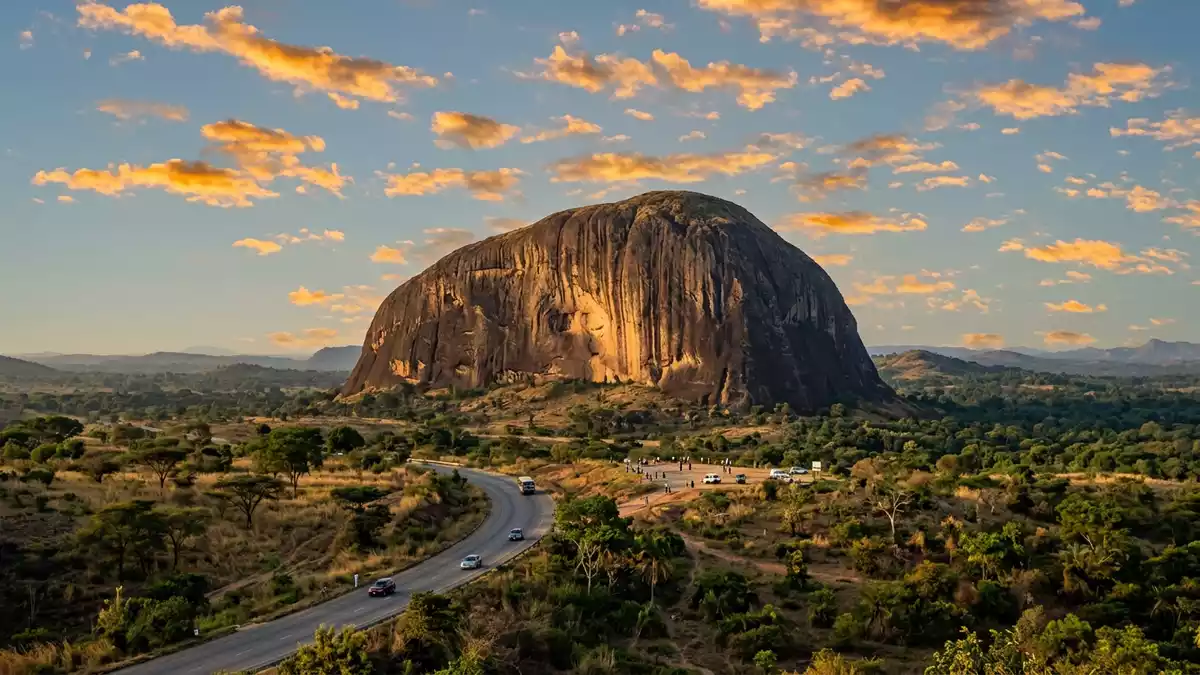
Rising from the savannah north-west of Abuja, Zuma Rock is a massive freestanding inselberg whose dark flanks and weathered “face” dominate the Abuja–Kaduna road. Formed from ancient igneous rock and linked to the Gbagyi people of central Nigeria, it stands as both a geological landmark and a cultural reference point for the capital’s wider landscape.
A monolith on the road from Abuja
Zuma Rock stands near the town of Madalla in Niger State, just beyond the boundary of the Federal Capital Territory and close to the highway that runs from Abuja towards Kaduna. Drivers leaving Abuja encounter the rock on the approach from Suleja, where it rises abruptly from the surrounding plains and has long been described as a kind of gateway on the northern approach to the capital.Madalla in Niger State
Geographers classify Zuma Rock as an inselberg, an isolated hill that stands apart from any continuous mountain chain and dominates the surrounding plain. Its core is an igneous intrusion composed largely of gabbro and granodiorite, rocks that crystallised deep beneath the Earth’s surface before later exposure through erosion of softer material.an isolated hill that stands
Height, geology and the “face” in the rock
The summit of Zuma Rock reaches an elevation of about 725 m (2,379 ft) above sea level, with the rock mass rising roughly 300 m (980 ft) above the surrounding terrain.about 725 m (2,379 ft) Its base has a circumference measured in kilometres, so from the roadside lay-bys it presents a broad wall of dark stone that fills much of the horizon.
Across one major face of the rock, weathering has created lighter vertical streaks and patches that resemble a human face, with darker hollows aligned like eyes and a mouth. This natural pattern is visible in many photographs and helps explain why the rock is one of Nigeria’s most recognisable silhouettes, reproduced on the country’s 100 naira banknote.on the country’s 100 naira banknote
Cultural landscape of the Gbagyi people
The area around Zuma Rock forms part of the homeland of the Gbagyi, also known as the Gwari, whose settlements extend across Niger State and the wider Middle Belt of Nigeria.the homeland of the Gbagyi Oral traditions describe the rock as a significant spiritual feature, and stories collected in the region link it to ancestral spirits and protective forces.
One widely circulated account traces the name to the word “Zumwa”, meaning “place of catching guineafowl” in an older local usage connected with the people of Zuba.the word “Zumwa” Over time, the rock has moved from a focal point within a rural cultural landscape to a national symbol, standing alongside Aso Rock in Abuja as one of the best known stone outcrops of central Nigeria.
Visiting Zuma Rock: what travellers from Western Europe should know
- Zuma Rock stands north-west of central Abuja, near Madalla on the main road towards Kaduna, and is reached by road journeys that leave the Federal Capital Territory for Niger State.
- The terrain around the base combines open roadside ground with rough, uneven paths on rock and soil. Any approach beyond the viewing points involves walking over natural surfaces rather than paved promenades.
- The wider region lies within Nigeria, where the official language is English and the currency is the Nigerian naira.
- Entry requirements depend on your nationality; UK travellers can check the FCDO travel advice at gov.uk/foreign-travel-advice, Irish travellers the Department of Foreign Affairs at ireland.ie.
Searching for Zuma Rock on social platforms
These links open searches for Zuma Rock on each platform.
Frequently asked questions about Zuma Rock
Where is Zuma Rock?
Zuma Rock is near Madalla in Niger State, north-west of Abuja, beside the main highway towards Kaduna and close to the boundary of the Federal Capital Territory.
What can visitors expect when they see it?
Visitors travelling by road see a vast wall of dark igneous rock rising sharply from the plains, with a weathered surface that carries the lighter markings of a face.
What makes Zuma Rock distinctive among Nigerian landmarks?
Zuma Rock combines the scale of an elevated inselberg with a naturally patterned “face” and stands as a cultural reference point for the Gbagyi people and the wider Abuja region.


