
Zuma Rock, the towering monolith on Abuja’s northern edge
Published on 08/22/2026 at 15:58 | Editorial responsibility: Rafael Müller, Editor-in-Chief AD HOC NEWS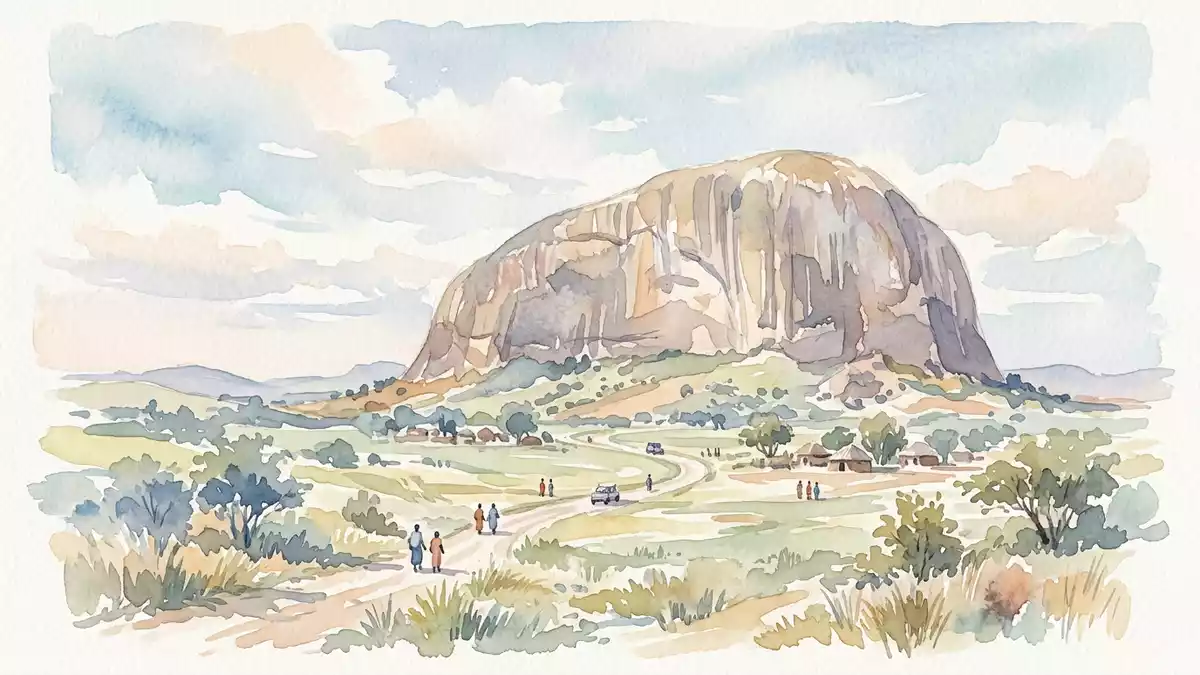
Zuma Rock is the great granite monolith that commands the northern approach to Abuja, rising steeply from the plains near the town of Madalla in Niger State. Its bulk, local face-like markings and position beside the Abuja–Kaduna road have turned this single mass of rock into one of the most recognisable natural landmarks in Nigeria, and a fixture of the country’s everyday imagery on the 100-naira banknote.
A single block of rock on the Abuja–Kaduna road
Zuma Rock stands on the boundary between the Federal Capital Territory and Niger State, beside the main highway that links Abuja with Kaduna to the north. Travellers heading out of the capital along this road meet the rock as the landscape opens, its steep flanks rising above the surrounding savannah and low settlements; for this reason it is widely described as the “Gateway to Abuja” from Suleja and the north-west.Gateway to Abuja The base of the rock sits near Madalla in Suleja Local Government Area, making it part of Niger State even though it is visually associated with Abuja.Madalla in Suleja
Geologically, Zuma Rock is an inselberg, a single isolated outcrop formed by the long-term erosion of the surrounding rock. Studies describe it as an igneous intrusion composed chiefly of gabbro and granodiorite from the Precambrian era, which means the mass beneath the weathered surface solidified deep underground long before the modern landscape took shape.igneous intrusion composed The result at ground level is a near-vertical block with a base circumference measured in kilometres, rising sharply from relatively gentle terrain rather than forming part of a continuous ridge.base circumference measured
Height, proportions and the “face” on the rock
Figures compiled from different surveys place Zuma Rock’s summit at around 725 m (2,379 ft) above sea level, with roughly 300 m (980 ft) of height above the surrounding plain. That difference between total elevation and relative height explains its visual impact: from the nearby road the viewer sees a cliff-like wall of rock rising several hundred metres in one sweep, anchored by a broad base that stretches far beyond a single viewpoint.height above the surrounding plain Descriptions of its footprint give a circumference of between 2.5 km and just over 3 km, underlining how large the formation is compared with other freestanding rocks in the region.circumference of between
One feature that visitors notice is a pattern on the rock’s surface which many interpret as a human face. This marking, visible on one of the main exposed walls, is created by variations in colour and weathering on the granite, along with streaks from water runoff. Over time it has entered local storytelling and tourism material, reinforcing the idea of Zuma Rock as a watchful presence over the road rather than simply a block of stone.face-like imprint on the rock The combination of sheer height, broad base and this distinctive marking makes it easy to recognise from a distance, including from parts of Abuja to the south-east.
A national symbol linked to Abuja
Although Zuma Rock lies outside the formal boundaries of the Federal Capital Territory, it has become a symbol closely associated with Abuja and the Nigerian federation as a whole. The rock appears on the reverse of the 100-naira banknote, securing its place in everyday transactions and making its silhouette familiar across the country.reverse of the 100-naira banknote Guidebooks and regional overviews pair it with Aso Rock, the granite outcrop within Abuja itself, as two natural landmarks that frame the capital from different directions.
Beyond banking imagery, Zuma Rock features regularly in travel writing and online guides to Nigeria’s central belt. These sources stress its role as a reference point on the Abuja–Kaduna route and highlight the fact that the rock is visible from many parts of the capital’s northern outskirts.reference point on the Abuja–Kaduna route Its status as a landmark has also led to the name being used for local businesses and developments, further embedding it in the everyday geography of Abuja and Niger State.
Visiting Zuma Rock: what travellers from Western Europe should know
- Zuma Rock stands north-west of central Abuja beside the Abuja–Kaduna highway near the town of Madalla in Niger State, and is approached by road from the capital.
- The landmark rises steeply from relatively flat terrain; viewing areas near the roadside are on level ground, while any approach closer to the base involves uneven, rocky surfaces.
- The surrounding landscape consists of open savannah, scattered trees and low buildings, with the rock dominating the skyline rather than forming part of a mountain chain.
- The official language of Nigeria is English and the currency is the Nigerian naira.
- Entry requirements depend on your nationality; UK travellers can check the FCDO travel advice at gov.uk/foreign-travel-advice, Irish travellers the Department of Foreign Affairs at ireland.ie.
Searching for Zuma Rock on social platforms
These links open searches for Zuma Rock on each platform.
Frequently asked questions about Zuma Rock
Where is Zuma Rock in relation to Abuja?
Zuma Rock stands north-west of Abuja beside the Abuja–Kaduna road near Madalla in Niger State, marking the approach to the capital from Suleja and the north.
What should visitors expect when viewing Zuma Rock?
Visitors see a steep granite mass rising several hundred metres from relatively flat terrain, with roadside viewpoints offering clear sightlines to its broad base and vertical flanks.
What makes Zuma Rock distinctive among Nigerian landmarks?
Zuma Rock is distinctive for its sheer height above the plains, its large base circumference and a natural face-like marking on its surface, alongside its appearance on the 100-naira note.


