
Banteay Srei’s pink sandstone carvings near Siem Reap
Published on 08/24/2026 at 22:46 | Editorial responsibility: Rafael Müller, Editor-in-Chief AD HOC NEWS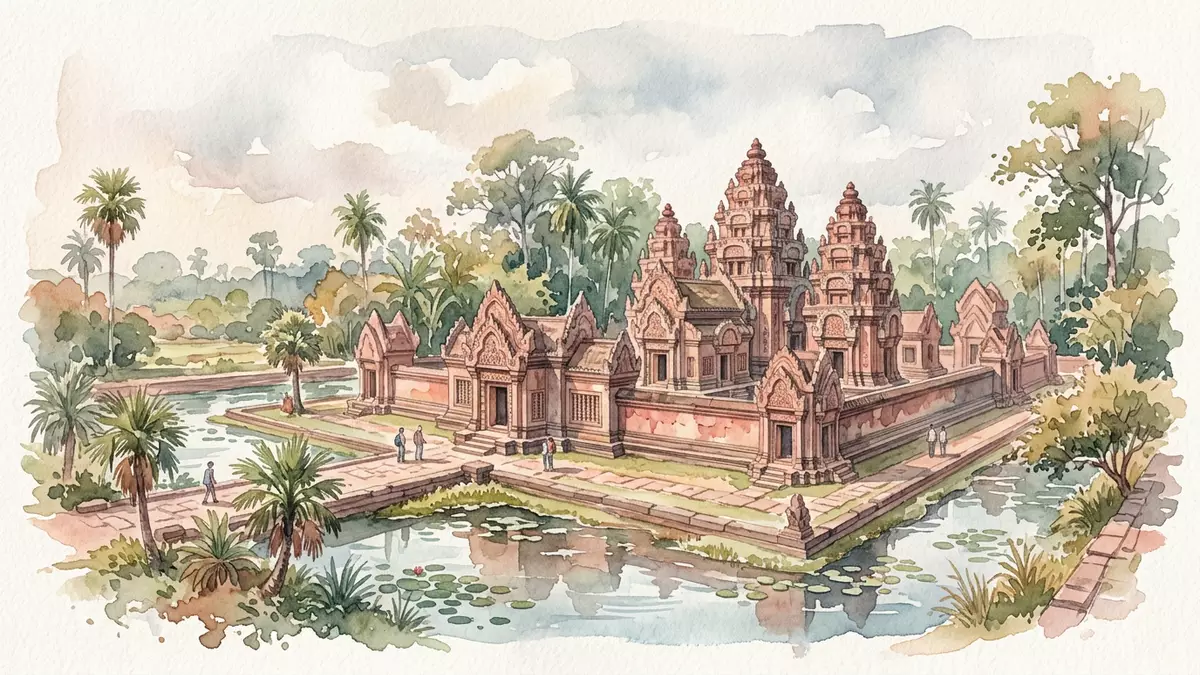
Banteay Srei near Siem Reap in Cambodia is a compact tenth-century Hindu temple where pink sandstone walls are covered with remarkably fine carvings, turning a small complex into a dense stone gallery of myth and ornament.
Pink sandstone and a human-scale Angkor temple
Banteay Srei stands north of the main Angkor temple group, in the countryside of Siem Reap Province, and forms part of the wider Angkor Archaeological Park in Cambodia.Angkor Archaeological Park It is a Hindu temple dedicated to Shiva, dating from the second half of the tenth century, during the reign of King Rajendravarman II.mid-tenth century construction Unlike the vast scale of Angkor Wat, the core of Banteay Srei is modest in footprint and height, bringing walls, doorways and pediments close to eye level rather than towering above.
The name Banteay Srei is often rendered in English as “Citadel of the Women”, and the temple has been described as a jewel-like example of Angkor-period architecture.Citadel of the Women It was commissioned by the Brahmins Yajnavaraha and Vishnukumara, senior figures at the Angkor court rather than kings themselves, an unusual origin among the temples of the region.commissioned by Yajnavaraha and Vishnukumara Their choice of finely grained red or pink sandstone gives Banteay Srei its distinctive warm colour and allows the sculptors’ work to reach an exceptional level of detail.
Layout, materials and carved stories in stone
The temple follows the east-facing orientation typical of many Angkor-period sites, with a processional causeway leading towards successive enclosures and a central sanctuary set within an inner court bordered by a moat.east-facing causeway and enclosures Laterite is used for outer walls and some structural cores, while the more refined sandstone appears on doorframes, pilasters, false doors and the richly carved pediments that crown entrances.sandstone and laterite construction Within the inner area, compact sanctuary towers rise from stone platforms, their surfaces layered with ornament.
Across these surfaces, Banteay Srei presents episodes from Hindu mythology alongside floral arabesques and geometric borders, all carved with striking precision into the sandstone.Hindu narratives in relief One noted scene shows the many-armed demon Ravana shaking Mount Kailasa, the abode of Shiva, rendered on an eastern pediment with layered figures and mountain forms.Ravana shakes Kailasa pediment Elsewhere, guardians stand in front of entrances, lintels carry rows of small figures, and floral motifs link the narrative panels, so that walking the temple becomes a close encounter with carved stone rather than a distant view of large walls.
Tenth-century context and later rediscovery
Banteay Srei was inaugurated in 967, during the period when the Angkor region was known by the name Ishanapura and before the construction of Angkor Wat in the twelfth century.inauguration in 967 Inscriptions link the temple with the learned Brahmin Yajnavaraha, counsellor to Rajendravarman II, and record its dedication to Shiva and other Hindu deities.inscriptional record The temple’s history includes later periods of use and restoration in subsequent centuries, reflecting the long religious and artistic life of the Angkor region.
By the twentieth century Banteay Srei had attracted attention for the refinement of its carvings, and conservation programmes formed part of the wider effort to protect Angkor’s monuments.conservation attention The temple’s scale and material help explain its enduring appeal: the pink sandstone surfaces sit within a rural setting, and the relatively low buildings bring architectural detail close to visitors rather than placing it high above. As part of the Angkor Archaeological Park, Banteay Srei now sits among numerous Khmer-era sites that together form one of Southeast Asia’s key historical landscapes.Angkor temple landscape
Visiting Banteay Srei: what travellers from Western Europe should know
- Banteay Srei lies north of the main Angkor temple group in Siem Reap Province, reached by road from central Siem Reap through the Angkor area towards the countryside.
- Within the temple, movement follows a causeway and stone paths through successive enclosures, with steps at entrances and raised platforms around the sanctuary towers.
- The official language is Khmer and the currency is the Cambodian riel.
- Entry requirements depend on your nationality; UK travellers can check the FCDO travel advice at gov.uk/foreign-travel-advice, Irish travellers the Department of Foreign Affairs at ireland.ie.
Searching for Banteay Srei on social platforms
These links open searches for Banteay Srei on each platform.
Frequently asked questions about Banteay Srei
Where is Banteay Srei located?
Banteay Srei is in Siem Reap Province in Cambodia, north of the main Angkor temple group and reached by road from the city of Siem Reap.
What should visitors expect at Banteay Srei?
Visitors can expect a compact Angkor-period temple built of pink sandstone, with closely spaced enclosures, stone paths, steps and richly carved walls and pediments.
What makes Banteay Srei distinctive among Angkor temples?
Banteay Srei stands out through its small scale and its red or pink sandstone, which carries unusually fine carvings of Hindu myth and ornament at eye level.


