
Fenghuang Gucheng and its riverfront wooden houses
Published on 09/10/2026 at 10:09 | Editorial responsibility: Rafael Müller, Editor-in-Chief AD HOC NEWS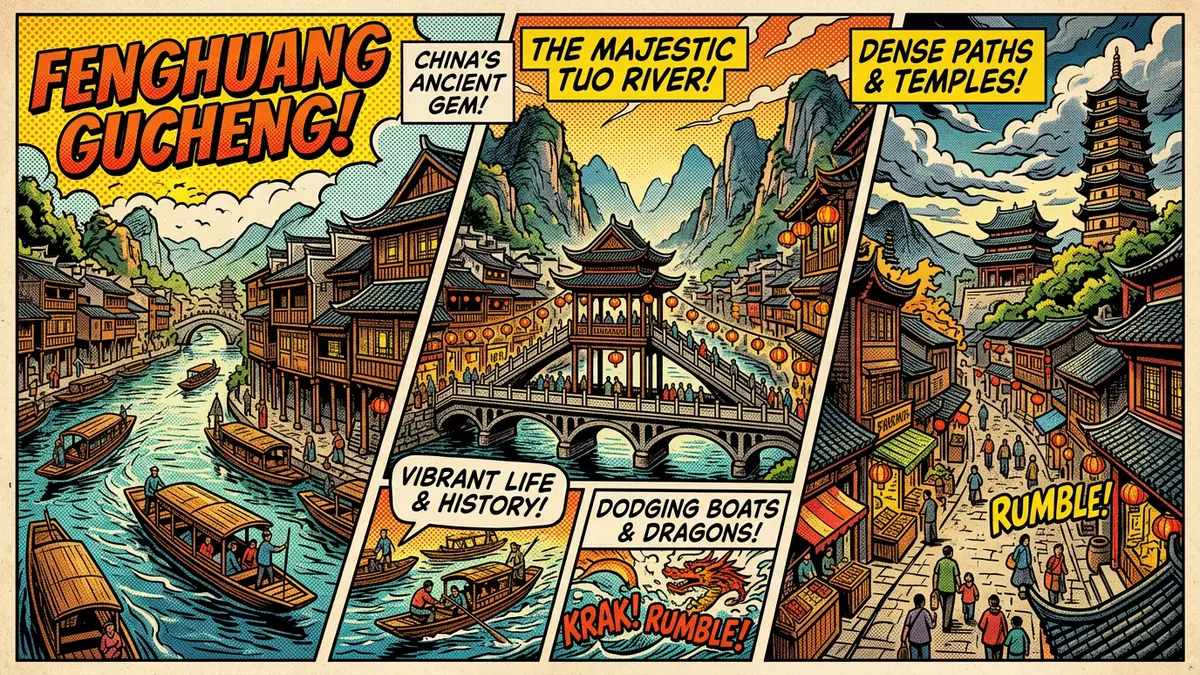
Fenghuang Gucheng is the historic core of Fenghuang in western Hunan, China. Its riverfront timber houses, stone lanes and stepped banks make the old town read as a compact riverside settlement.
Wood, stone and the Tuojiang River
The strongest impression is the line of wooden houses beside the Tuojiang River, where upper storeys project over the water on timber supports. Stone steps, narrow landings and gallery fronts give the river edge a layered, vertical character.
Fenghuang Gucheng belongs to the late-imperial building world of western Hunan, where wood, stone and tiled roofs work together in closely packed streets. The town is formally recognised as a national historical and cultural town, and that status fits a streetscape defined by preserved houses, lanes and riverfront edges.
Kangxi-era streets in western Hunan
The present old town is widely dated to the Qing dynasty, with a built form associated with the reign of Emperor Kangxi. That gives Fenghuang Gucheng a clear place in the late seventeenth and early eighteenth centuries, even as earlier layers remain part of the town’s broader history.
The streets carry Ming and Qing period features in their proportions, rooflines and timber detailing. Residences, shrines and small public buildings stand close together, creating a dense urban fabric rather than a single monumental centre.
Miao and Tujia influences in the old town
Fenghuang Gucheng is also known for its mix of Han, Miao and Tujia cultural traditions. That blend appears in the timber construction, carved woodwork and the domestic architecture along the river and in the side lanes.
The town’s setting in Fenghuang County places it within western Hunan’s mountain landscape, where settlement follows the river corridor and the streets adapt to the slope. The result is a townscape of bridges, steps, terraces and close-set buildings rather than broad ceremonial spaces.
Visiting Fenghuang Gucheng: what travellers from Western Europe should know
- Fenghuang Gucheng lies in Fenghuang County, western Hunan, China, and the old town sits along the Tuojiang River.
- The streets include steps, narrow lanes and river edges with changes in level.
- The town is linked with the Kangxi period of the Qing dynasty and with Ming and Qing period domestic architecture.
- Fenghuang Gucheng is associated with Han, Miao and Tujia cultural traditions.
Searching for Fenghuang Gucheng on social platforms
These links open searches for Fenghuang Gucheng on each platform.
Frequently asked questions about Fenghuang Gucheng
Where is Fenghuang Gucheng?
Fenghuang Gucheng is in Fenghuang County in western Hunan, China, along the Tuojiang River.
What should a visit expect?
The old town is a riverfront district of timber houses, stone edges and narrow lanes with changes in level.
What makes Fenghuang Gucheng distinctive?
Its identity comes from the combination of late-imperial urban fabric, riverfront wooden buildings and Miao and Tujia cultural influences.


