
Monasterio de Santa Catalina, Arequipa’s painted cloister city
Published on 08/23/2026 at 12:07 | Editorial responsibility: Rafael Müller, Editor-in-Chief AD HOC NEWS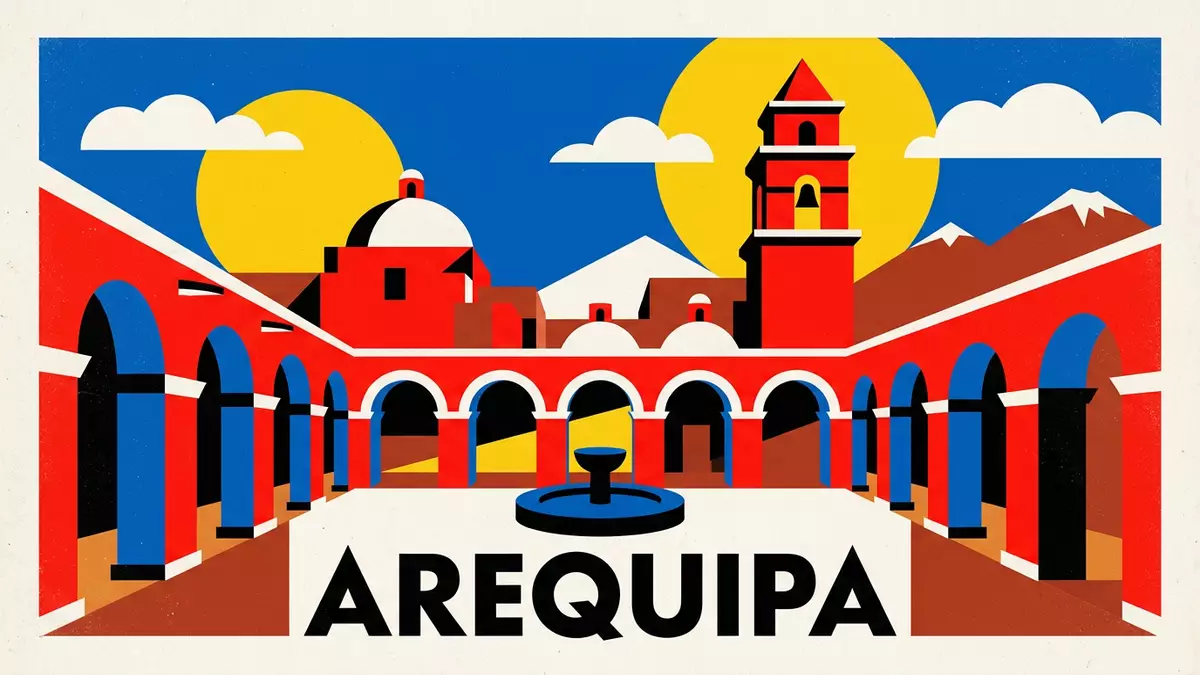
Monasterio de Santa Catalina in Arequipa is a walled Dominican convent that grew into a self-contained cloistered quarter, with streets, courtyards and chapels enclosed within high stone walls. Its history reaches back to the late sixteenth century, when the community was founded under Spanish colonial rule and named for Saint Catherine of Siena, bringing a distinct cloister city into the centre of southern Peru.
A monastery born from a widow’s vision in colonial Arequipa
The roots of Monasterio de Santa Catalina lie in the period when Arequipa was a young colonial city, founded in 1540 in the southern highlands of Peru. In the 1570s a Dominican community of nuns was established here, forming a convent formally founded in 1579 under the authority of Viceroy Francisco de Toledo and the wider framework of the Viceroyalty of Peru.founded in 1579 A wealthy widow from Arequipa, Doña María de Guzmán, is recorded as providing the fortune and property that made the project possible and as entering as the first prioress, linking the convent closely to the city’s Spanish elite.rich widow Doña María de Guzmán
The monastery’s full name, Monasterio de Santa Catalina de Siena, honours the fourteenth-century Italian mystic associated with the Dominican tradition, but the daily life that unfolded behind its walls was rooted firmly in Arequipa. For centuries entry was reserved for women from upper-class Spanish families who paid substantial dowries; they lived under strict cloistered rules and rarely, if ever, left the complex.upper-class Spanish families Over time the monastery expanded with additional cloisters, chapels and domestic quarters, creating a network of religious and everyday spaces that filled an entire city block in the historic centre.occupying an entire city block
Painted streets and sillar stone: a cloistered city within the city
Walking through Monasterio de Santa Catalina feels like entering a small city of painted walls and stone lanes enclosed within a single convent. The complex occupies around 20,000 square metres in the heart of Arequipa, its perimeter walls wrapped around interior streets, cells, cloisters and small plazas.over 20,000 square metres Within this enclosure, lanes named after Spanish cities lead past rows of simple cells and more elaborate houses, some with inner courtyards and kitchens that recall the domestic life of the nuns and their servants.streets, bakery and laundry
Architecturally, the monastery is strongly shaped by sillar, the pale, porous stone cut from local volcanic deposits and widely used in Arequipa’s historic centre.sillar, a porous stone formed by volcanic lava Thick sillar walls frame arcaded cloisters and chapels, while carved stone details and wooden doors add texture to the passages. Many of the surfaces are coated in deep reds and blues, with contrasting white trim, giving the courtyards and streets a distinctive palette against the highland light.carved sillar and decorative tiling Within the cloisters, planted trees and stone basins bring greenery and water into the otherwise mineral setting.
Cloisters, chapels and artworks inside the convent walls
The interior of Monasterio de Santa Catalina is organised around a series of cloisters, each with its own character and associated spaces. The Novice Cloister, entered through an arch marked with the word silencio, is centred on a courtyard with a large rubber tree; this was where new entrants spent their first years of religious life under especially strict discipline.Novice Cloister and rubber tree Nearby, the Orange Cloister is named for the orange trees at its centre and connects to the Profundis Room, a mortuary space in which deceased nuns were mourned, its walls lined with paintings of the dead.Orange Tree Cloister and Profundis Room
Further into the complex, the Great Cloister and associated gallery display religious artworks that reflect the blend of European and Andean influences found across the monastery. Paintings and sculptures show saints and biblical scenes in styles linked to Baroque and later colonial currents, while tiled surfaces and decorative details draw on Iberian Mudéjar traditions and local craft.colonial and Mestizo Baroque architecture Domestic rooms such as kitchens and laundries, preserved with ovens, troughs and simple furnishings, offer a glimpse of everyday convent work alongside the more overtly religious spaces.
Visiting Monasterio de Santa Catalina: what travellers from Western Europe should know
- Monasterio de Santa Catalina stands in Arequipa’s historic centre, occupying a full block along Calle Santa Catalina a short walk north of the Plaza de Armas in southern Peru.
- The complex is enclosed by high sillar stone walls; visiting the interior involves walking on stone paving through narrow lanes and stairways, with uneven surfaces and several cloister courtyards.
- Arequipa lies in the Andes at altitude, so the monastery’s courtyards and terraces sit above sea level and visits combine urban walking with the thinner air of the highlands.
- The official language is Spanish and the currency is the Peruvian sol.
- Entry requirements depend on your nationality; UK travellers can check the FCDO travel advice at gov.uk/foreign-travel-advice, Irish travellers the Department of Foreign Affairs at ireland.ie.
Searching for Monasterio de Santa Catalina on social platforms
These links open searches for Monasterio de Santa Catalina on each platform.
Frequently asked questions about Monasterio de Santa Catalina
Where is Monasterio de Santa Catalina located?
Monasterio de Santa Catalina stands in the historic centre of Arequipa in southern Peru, occupying an entire block along Calle Santa Catalina near the Plaza de Armas.
What can visitors expect inside the monastery complex?
Visitors encounter a network of painted streets, cloisters, chapels and domestic rooms built in sillar stone, including spaces such as the Novice Cloister, Orange Cloister and Profundis Room.
What makes Monasterio de Santa Catalina distinctive among convents in Peru?
Its scale as a walled cloister city, its use of local sillar stone and its blend of Spanish colonial, Baroque and Andean influences in architecture and artworks give it a distinctive character.


